
When choosing an aluminium boat, one of the first questions many buyers ask is how thick the aluminium should be.
It is a reasonable question. The thickness of an aluminium boat hull can influence its strength, weight, durability and ability to handle demanding conditions. However, choosing an aluminium boat is not as simple as looking for the largest thickness number.
A small boat used on calm rivers does not have the same requirements as a large offshore fishing boat. The right aluminium boat thickness depends on several factors, including the size of the vessel, hull design, marine-grade alloy, internal reinforcement and the conditions where the boat will be used.
For Australian anglers, particularly those looking at aluminium plate boats for coastal or offshore fishing, understanding these differences can help you make a much more informed decision.
What is the best thickness for an aluminium boat?
There is no single aluminium thickness that is best for every boat.
Aluminium boat manufacturers use different plate thicknesses depending on the size, design and intended application of the vessel. Smaller recreational boats can use thinner aluminium, while larger offshore and heavy-duty fishing boats often use thicker plate.
Real-world boat specifications demonstrate this variation. Some aluminium boats use 4mm side plates with 5mm bottom plates, while larger offshore boats can use 6mm aluminium throughout significant sections of the hull.
This means the better question is not simply:
“Is 4mm or 6mm aluminium better?”
Instead, ask:
“Is the aluminium thickness appropriate for this boat’s size, design and intended use?”
That distinction is important when comparing aluminium boats.
Why aluminium boat hull thickness matters
The thickness of an aluminium plate affects its resistance to bending, impact and deformation.
A thicker aluminium plate generally provides more material and can offer greater resistance to damage. This can be particularly valuable for boats operating in rough water, regularly travelling offshore or carrying substantial loads.
However, thicker aluminium also means additional weight.
Extra weight can affect:
- Fuel consumption
- Acceleration
- Engine requirements
- Payload
- Trailer capacity
- Towing requirements
- Launching and retrieval
- Overall handling
For this reason, simply choosing the thickest aluminium boat available is not necessarily the best approach.
A well-designed hull uses an appropriate combination of aluminium plate thickness, structural reinforcement and hull geometry to achieve the required strength without unnecessary weight.
Is thicker aluminium always better?
No.
It is easy to assume that a 6mm aluminium hull must automatically be stronger or better than a 4mm hull. In reality, boat construction is much more complicated.
Two boats can have different aluminium thicknesses and still have very different structural characteristics.
Internal components such as:
- Stringers
- Frames
- Bulkheads
- Keels
- Chines
- Transoms
all contribute to the overall strength of the hull.
Hull shape also affects how loads are distributed through the structure.
A boat with carefully designed framing and reinforcement can achieve excellent structural strength without simply increasing the thickness of every aluminium plate.
The best aluminium boat construction therefore balances plate thickness with structural design.
Common aluminium boat thicknesses
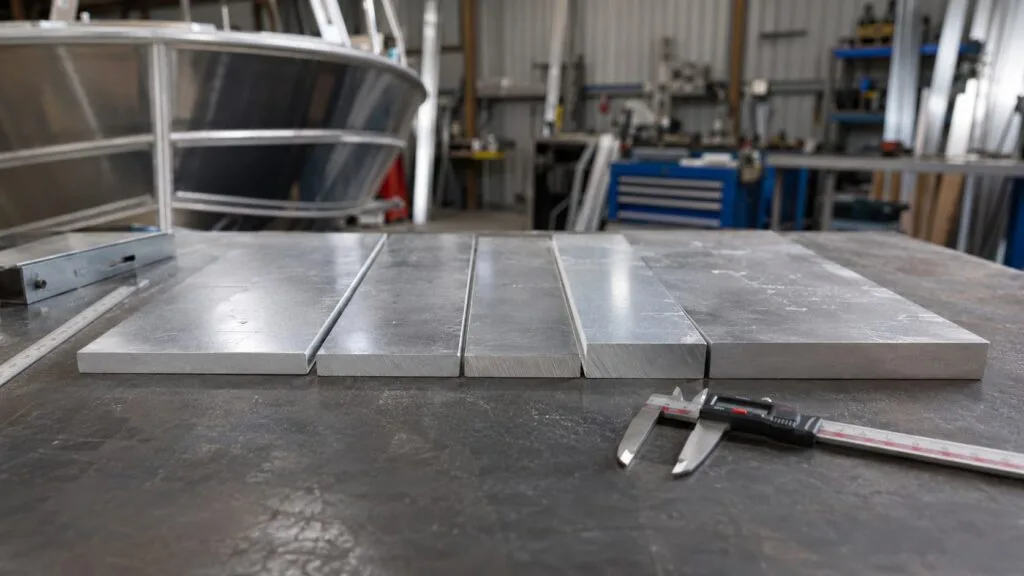
There is no universal thickness requirement for every boat. However, looking at real-world construction provides a useful indication of the different aluminium plate thicknesses used across recreational and fishing boats.
2mm to 3mm aluminium
Thinner aluminium can be suitable for smaller recreational boats operating in relatively sheltered conditions.
Some smaller aluminium boats use 3mm 5083 marine-grade aluminium in parts of their construction. Published specifications show examples where smaller models use 3mm material before moving to thicker plate on larger boats.
The main advantage is reduced weight.
The trade-off is that thinner plate can be more susceptible to deformation and impact if it is not properly supported and reinforced.
For a small boat used on calm inland waterways, this may be perfectly appropriate.
For a larger offshore fishing boat, the requirements are very different.
4mm aluminium
4mm aluminium is used across a range of recreational and fishing boat designs.
It can provide a useful balance between weight and strength, particularly when combined with appropriate framing and hull reinforcement.
It is also common for manufacturers to use 4mm aluminium for the sides of a boat while specifying thicker material for the bottom.
This reflects the fact that different parts of the hull experience different forces.
5mm aluminium
5mm aluminium plate provides additional material thickness and is commonly found in larger aluminium fishing boats.
Some published boat specifications use 5mm bottom plate with thinner side plate, while other designs use 5mm throughout particular sections of the hull.
Whether 5mm is appropriate depends on the boat’s size, hull design and intended operating conditions.
6mm aluminium
6mm aluminium is frequently associated with larger, heavier-duty and offshore-oriented aluminium boats.
Australian boat specifications provide examples of boats around the 6 metre to 7 metre range using 6mm 5083 marine-grade aluminium for significant sections of the hull.
A 6mm plate provides greater material thickness and can offer increased resistance to impacts and deformation.
However, the benefits need to be considered alongside the additional weight.
What thickness is best for offshore fishing?
Offshore fishing places considerably greater demands on an aluminium hull than calm-water boating.
An offshore boat can encounter:
- Larger waves
- Greater impacts
- Rough landings
- Higher speeds
- Heavier engines
- Larger fuel loads
- More passengers
- Additional fishing equipment
This is why larger offshore aluminium boats often use more substantial plate construction and structural reinforcement.
Australian examples show larger offshore fishing boats using 6mm 5083 marine-grade aluminium in major sections of the hull. Some use 6mm bottom and side plate, while other designs combine thicker bottom plate with thinner sides.
There is no rule stating that every offshore boat must use 6mm aluminium.
The appropriate specification depends on the entire hull design and the conditions for which the boat has been engineered.
Should the bottom of an aluminium boat be thicker than the sides?
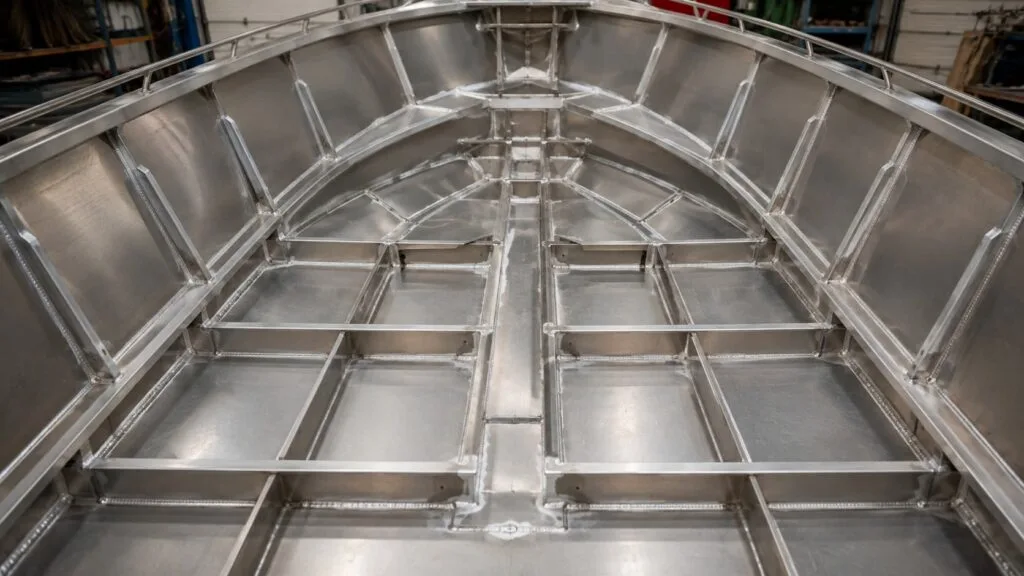
In many boat designs, yes.
The hull bottom experiences different forces from the sides. It is exposed to water pressure, impacts and loads generated as the boat moves through waves.
As a result, manufacturers may use a thicker aluminium bottom plate than the side plate.
For example, published specifications for aluminium boats include combinations such as 6mm bottom plate with 4mm side plate.
This does not mean that equal thickness throughout a hull is inferior.
It simply demonstrates that the aluminium thickness can be selected according to the structural requirements of each part of the boat.
When comparing boats, therefore, ask for the thickness of the:
- Bottom plate
- Side plates
- Transom
- Keel
- Other reinforced areas
rather than asking only for one overall thickness.
What thickness should an aluminium boat transom be?
The transom is another area that deserves attention.
On an outboard-powered fishing boat, the transom supports the engine and transfers its weight and thrust into the rest of the hull.
Larger engines create greater loads, particularly when the boat is travelling through rough water.
For this reason, the transom thickness and its reinforcement can be just as important as the hull bottom thickness.
Published specifications for larger aluminium boats show examples of 6mm transoms alongside thinner side plates, while larger models can use even more substantial transom construction.
If you are comparing fishing boats, ask how the transom has been constructed and what engine size it has been designed to support.
Does marine-grade aluminium make a difference?
Yes.
Aluminium thickness is only one part of the specification. The alloy used for the hull also matters.
Marine boat construction commonly uses alloys selected for their strength, corrosion resistance and welding characteristics.
5083 marine-grade aluminium is widely used in marine applications and aluminium boat construction.
Technical marine construction material includes examples of 5083 and 6082 aluminium plate being used in vessels with plate thicknesses in the 4mm to 6mm range.
This highlights an important point for buyers.
Knowing that a boat is made from “aluminium” is not enough.
You should ask:
- What aluminium alloy is used?
- Is it marine-grade aluminium?
- What is the bottom plate thickness?
- What is the side plate thickness?
- What is the transom thickness?
- How is the hull reinforced?
- How are the plates welded?
- What conditions is the boat designed for?
These details give you a much better understanding of construction quality.
Why hull design matters as much as aluminium thickness
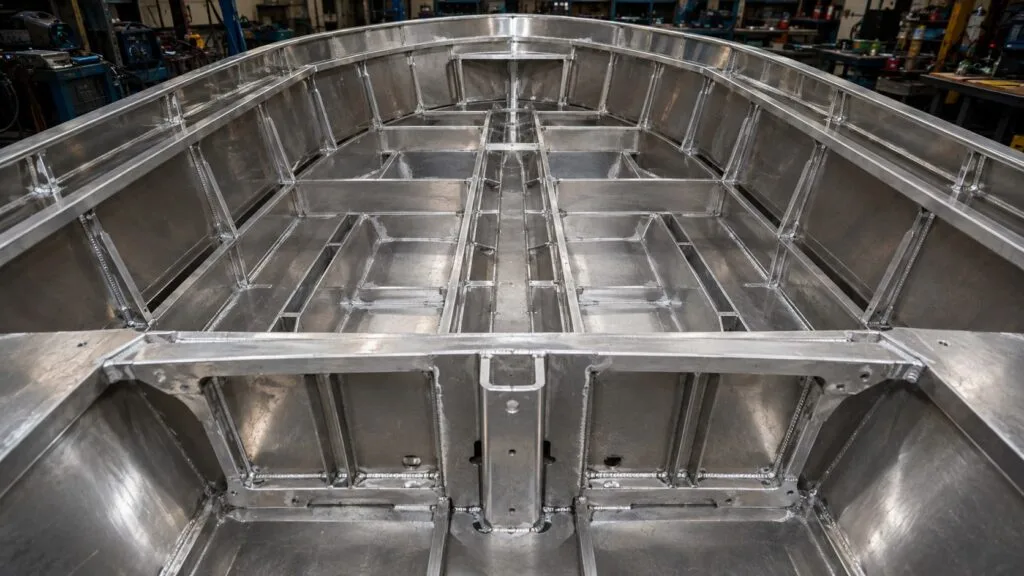
A strong aluminium boat is not simply made by increasing plate thickness.
The entire hull works as a structural system.
Stringers
Stringers provide longitudinal support and help control flex in the hull plates.
Their size, spacing and connection to other structural components can have a significant effect on hull rigidity.
Frames
Frames provide additional transverse support and help maintain the shape of the hull.
Bulkheads
Bulkheads can strengthen the structure while also separating internal compartments.
Keel
The keel is an important structural component and can require additional reinforcement depending on the hull design.
Chines
Chines form part of the hull’s geometry and can contribute to both structural strength and handling characteristics.
Transom
The transom supports the outboard and transfers engine loads through the hull.
Together, these components determine how effectively the boat handles the forces generated during operation.
This is why aluminium boat construction should always be assessed as a complete system rather than judged by plate thickness alone.
How does aluminium thickness affect boat weight?
The thicker the aluminium, the more material is used.
That means a boat constructed with heavier plate will generally weigh more than an otherwise similar boat using thinner plate.
Additional weight is not necessarily a negative.
A heavier hull can provide a solid, substantial feel and may be appropriate for offshore conditions.
However, increased weight can affect:
- Engine performance
- Fuel consumption
- Towing requirements
- Trailer selection
- Payload
- Launching
- Acceleration
For this reason, boat builders need to strike the right balance between hull strength and boat weight.
A well-engineered aluminium boat uses enough material to meet its structural requirements without adding unnecessary mass.
What aluminium thickness is best for a fishing boat?
The answer depends heavily on where and how you fish.
A small aluminium fishing boat used on rivers and sheltered lakes may not require the same construction as a large offshore fishing boat.
For larger fishing boats, buyers should consider the complete specification rather than focusing on one number.
Look at:
- Aluminium alloy
- Bottom thickness
- Side thickness
- Transom thickness
- Stringer construction
- Frame spacing
- Keel design
- Hull shape
- Overall weight
- Recommended engine range
The boat should be designed around the conditions where it will be used.
A boat intended for offshore Australian fishing needs to account for considerably more demanding conditions than one designed for calm inland waters.
What thickness aluminium does Sea Raider use?
Sea Raider Boats provides a useful example of how aluminium boat thickness can vary according to the size and purpose of a vessel.
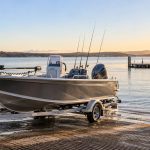
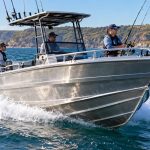
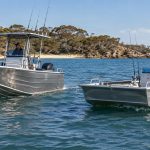
The Sea Raider 6.25m Pro Fisher is constructed from 6mm 5083 marine-grade aluminium, with published specifications listing 6mm bottom-side material, 4mm topsides and a 5mm transom. It also features a foam-filled hull and is designed for an outboard range of 150hp to 200hp. (searaider.com.au)
The 7.5m Pro Fisher uses 6mm 5083 marine-grade aluminium, with published specifications listing 6mm bottom-side material and a 6mm transom. The model has a listed dry weight of 1,700kg and is designed for engines between 250hp and 350hp. (searaider.com.au)
The larger 9.6m Pro Fisher is listed with 6mm bottom-side material and an 8mm transom, with a listed dry weight of 3,200kg. (searaider.com.au)
These specifications demonstrate why it is useful to look beyond a single thickness figure.
Sea Raider varies the construction specification between models and components according to the requirements of each boat.
How to compare aluminium boat thickness before buying
If you are comparing aluminium boats, ask the manufacturer for the detailed hull construction specifications.
Start with the alloy, then look at the thickness of each important section.
Check the bottom plate
Ask how thick the bottom plate is and whether it is reinforced.
The bottom is exposed to different forces from the sides, particularly when travelling through rough water.
Check the side plates
Side plate thickness can vary considerably between models.
A thinner side plate is not automatically a weakness if it is appropriate for the hull design and supported correctly.
Check the transom
Find out how thick the transom is and how it has been reinforced for the intended engine.
Look at the internal structure
Ask about:
- Stringers
- Frames
- Bulkheads
- Keel
- Chines
- Welds
This information can tell you considerably more about the boat’s overall construction than a single thickness figure.
Consider the boat’s intended use
Think honestly about where you will use the boat.
If you primarily fish calm rivers and lakes, your requirements may be very different from someone regularly heading offshore.
Your typical passenger load, engine size, fuel capacity and fishing equipment should all be considered.
Is a 6mm aluminium boat worth it?
For some applications, yes.
A 6mm aluminium hull can provide a substantial level of material thickness and is commonly used in larger fishing and offshore boats.
But whether it is worth the additional weight and cost depends on the boat’s intended use.
If you are comparing a 4mm boat with a 6mm boat, do not automatically choose the thicker one.
Instead, compare the complete construction.
Ask why the manufacturer chose that particular thickness, how the hull is reinforced and what conditions the boat has been designed to handle.
The best choice is the boat that provides the right combination of strength, weight, durability and performance for your needs.
Frequently Asked Questions
There is no universal answer. The ideal aluminium boat thickness depends on the boat’s size, hull design, alloy, reinforcement and intended operating conditions.
It can be suitable for some smaller aluminium boats, particularly when the hull has been properly designed and reinforced. It is not automatically suitable for larger offshore boats. Published specifications show 3mm 5083 aluminium being used in some smaller boat construction.
Yes, 4mm aluminium can be suitable for various fishing boat applications. It is particularly common for side plates or smaller hulls. Its suitability depends on the overall hull construction and intended use.
5mm aluminium can be used in offshore fishing boats, but there is no universal requirement. The boat’s length, design, reinforcement, alloy and operating conditions all need to be considered.
6mm aluminium provides greater material thickness and can be appropriate for larger or offshore boats. However, thicker aluminium also adds weight, so it is not automatically better for every application.
Many aluminium boat designs use a thicker bottom plate than side plates because the bottom experiences different loads. Examples include boats using 6mm bottom plate with 4mm sides.
Marine-grade alloys are selected for properties including strength, corrosion resistance and weldability. 5083 is widely used in marine boat construction and is used throughout Sea Raider’s Pro Fisher range.
Yes. 5083 is widely used for marine applications and aluminium boat construction. Sea Raider uses 5083 marine-grade aluminium across its Pro Fisher range, including substantial plate thicknesses on its larger models.
Thickness can increase resistance to bending and impact, but overall strength depends on much more than plate thickness. Hull design, frames, stringers, bulkheads, keel, transom and welding all contribute to structural performance.
There is no single thickness that applies to every offshore boat. Larger offshore boats commonly use heavier plate, with 6mm construction found in a number of real-world examples, but the complete structural design should be considered before choosing a boat.
Final thoughts
So, what thickness aluminium is best for a boat?
The answer depends on what the boat is designed to do.
Smaller recreational boats can use thinner aluminium when the material is properly supported and the hull is designed for the intended conditions. Larger fishing and offshore boats often use thicker plate because they face greater loads, impacts and demanding operating environments.
However, aluminium thickness should never be considered in isolation.
When comparing boats, look at the aluminium alloy, hull thickness, bottom plate, side plates, transom, stringers, frames, keel, welds and overall hull design.
For Australian anglers, this is particularly important when comparing boats intended for offshore fishing. A boat designed for serious coastal conditions needs more than a thick sheet of aluminium. It needs a complete structure engineered around the conditions it will encounter.
Sea Raider’s Pro Fisher range illustrates this approach, using 5083 marine-grade aluminium and different thickness specifications across its models and hull components. The construction changes as the boats become larger and are designed to handle greater loads.
Ultimately, the best aluminium boat is not necessarily the one with the thickest plate.
It is the one where aluminium alloy, plate thickness, hull design and structural reinforcement have been properly matched to the way you intend to use the boat.