Deep V vs Flat Bottom Aluminium Boats
A Deep-V aluminium boat is generally the better choice for offshore fishing, coastal waters and rougher conditions because its deeper hull angle is designed to cut through waves and provide a softer ride. A flat-bottom aluminium boat is generally better for shallow, calm water because it has a shallow draft, good stability at rest and efficient performance in protected waterways. Neither hull is universally better. The right choice depends on where you fish, the conditions you expect to encounter and how you use your boat.
Choosing the right aluminium boat is not simply a matter of deciding how big you want it to be or how much equipment you can fit onboard. The shape of the hull has a major influence on how a boat behaves on the water, and one of the biggest decisions for anglers is whether a Deep-V or flat-bottom design is right for their needs.
Both hull types have their strengths. Flat-bottom aluminium boats are well known for their shallow draft, stability and ability to access areas where deeper boats cannot go. Deep-V aluminium boats, on the other hand, are designed to handle waves and chop more comfortably, making them particularly attractive to anglers who regularly fish coastal waters or head offshore.
So, when comparing Deep V vs Flat Bottom Aluminium Boats, which one is better? The answer depends on your fishing environment, the conditions you expect to encounter and what you value most in a boat.
What Is a Deep-V Aluminium Boat?
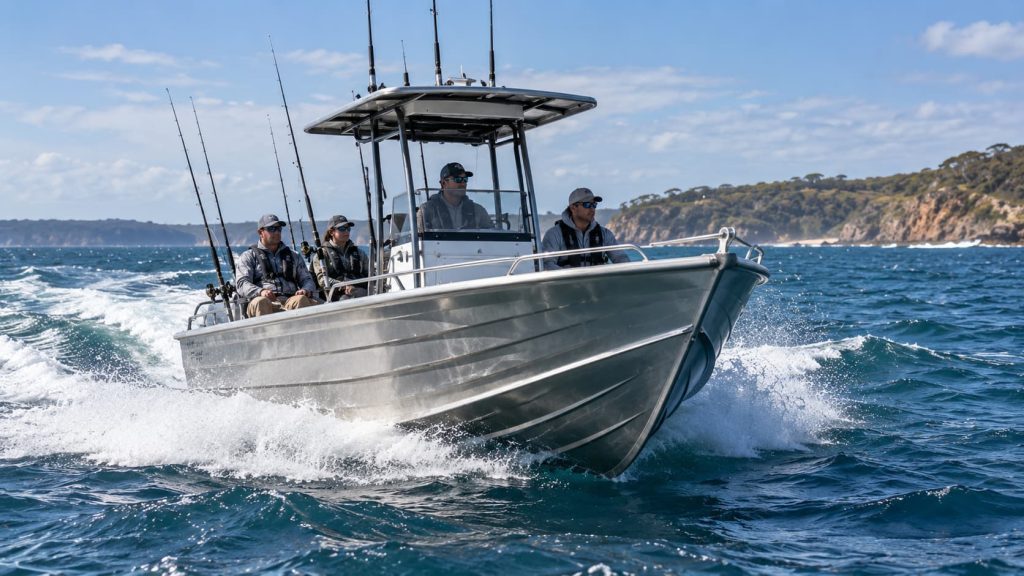
A Deep-V aluminium boat has a pronounced V shape running along the bottom of the hull. The angle of this V is known as deadrise, and a deeper V generally means a greater deadrise angle at the transom. Instead of hitting waves with a relatively flat surface, the sharper hull shape allows the boat to move through waves at an angle.
This design is particularly useful when conditions become rough. As the hull meets a wave, the V-shaped bottom helps reduce the amount of flat hull surface striking the water at once, which can result in a softer ride and better handling through chop. Deep-V hulls are therefore commonly associated with offshore fishing and open-water boating. They can also provide better directional tracking and a more controlled ride when travelling through moderate waves.
The trade-off is that a deeper V usually places more of the hull below the water. This can increase draft and drag and may require more engine power to achieve the same performance as a flatter hull. Deep-V boats can also feel less stable when sitting still compared with a flatter hull, particularly when several people are moving around the deck.
What Is a Flat-Bottom Aluminium Boat?
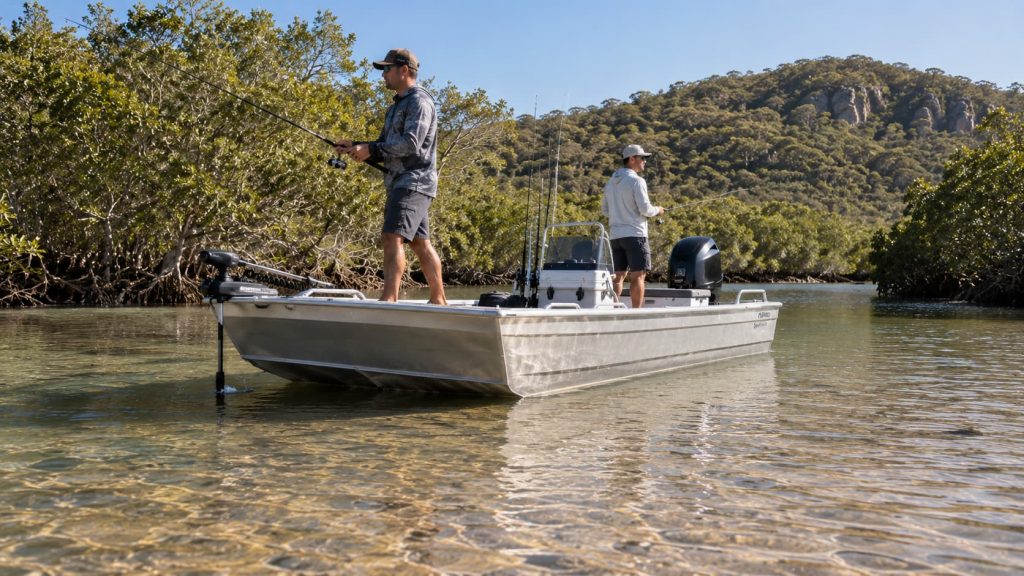
A flat-bottom aluminium boat has very little deadrise compared with a Deep-V hull. The bottom is relatively flat across much of its width, giving the boat a broad surface that sits on top of the water.
The main advantage is shallow-water capability. Because the hull does not extend as deeply into the water, a flat-bottom aluminium boat can operate in areas that may be inaccessible to a deeper boat. This makes flat-bottom designs popular for rivers, lakes, shallow creeks, marshes and other protected waterways.
Flat hulls can also feel very stable when sitting still on calm water. That can be useful when fishing, particularly when anglers are standing, moving around the deck or casting from different positions. The downside becomes more obvious when the water gets rough. A relatively flat hull can produce a harsher ride as it encounters waves because there is less V-shaped surface to soften the impact.
For this reason, a flat-bottom aluminium boat can be an excellent choice for the right environment, but it is not automatically the best option for coastal or offshore fishing.
Deep V vs Flat Bottom Aluminium Boats: The Main Differences
The biggest difference between these two aluminium boat hull types is how they interact with the water.
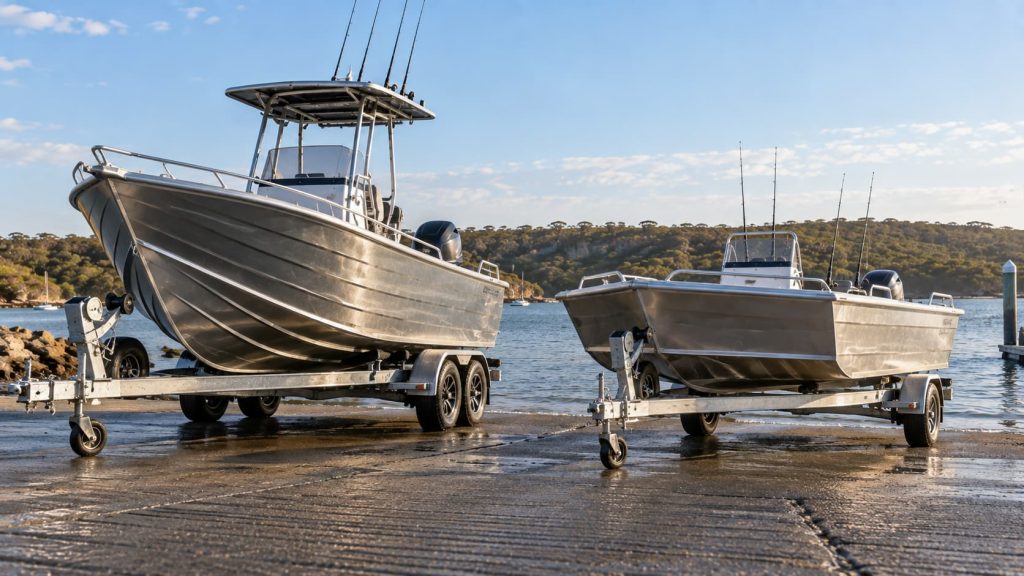
A Deep-V hull is designed to move through waves, while a flat-bottom hull is designed to sit higher and run efficiently across relatively calm, shallow water. This difference affects almost every aspect of the boating experience, including ride comfort, stability, draft, handling, fuel use and where you can safely operate.
Ride Comfort
If ride comfort is one of your priorities, a Deep-V aluminium boat generally has the advantage.
The angled hull is better suited to cutting through chop rather than landing heavily on top of each wave. This becomes increasingly noticeable as conditions deteriorate. On calm water, the difference may not matter much, but on a windy afternoon with short, closely spaced waves, hull design can make a major difference to how comfortable the trip feels.
A flat-bottom boat can be perfectly comfortable on smooth water, but its flatter surface can produce a harder ride when travelling across chop. The boat may bounce or pound more noticeably, particularly at higher speeds.
For anglers who spend most of their time on calm rivers and lakes, this may not be a concern. For anyone regularly crossing exposed bays or heading offshore, however, ride quality becomes much more important.
Stability at Rest
Flat-bottom aluminium boats generally have an advantage when it comes to stability at rest.
The wider, flatter hull provides a broad platform that can feel very stable when the boat is sitting still. This can be particularly useful for fishing in calm water, where anglers may spend long periods standing, casting and moving around the deck.
Deep-V boats can feel more stable once they are underway, particularly in rough water, but their deeper hull shape can result in more side-to-side movement when stationary. This is one of the trade-offs that comes with choosing a hull designed to perform better in waves.
It is worth remembering that stability is not simply determined by whether a boat is flat or V-shaped. Beam, hull width, weight distribution, freeboard, hull design and loading all influence how a boat behaves.
Shallow-Water Performance
If you regularly fish shallow rivers, creeks, flats or lakes, a flat-bottom aluminium boat can be extremely practical.
Its shallow draft allows you to access areas that may be difficult or impossible to reach in a deeper boat. This can open up fishing locations that are inaccessible to larger offshore-style vessels.
Deep-V aluminium boats generally require more water beneath the hull, which means they are not as well suited to extremely shallow environments. Their deeper hull is part of what gives them better rough-water performance, so there is naturally a compromise between offshore capability and shallow-water access.
If most of your fishing involves navigating shallow water, there is little reason to choose a Deep-V simply because it is considered a more capable hull. The best hull is the one that suits the water you actually fish.
Offshore Performance
For offshore fishing, a Deep-V aluminium boat is generally the more appropriate choice.
Once you leave protected waterways, conditions can change quickly. Wind can build, waves can increase and a calm morning can turn into an uncomfortable trip home. A hull designed to handle waves can make a significant difference in these conditions.
The deeper V helps the boat work through waves rather than simply riding over the top of them. This can improve ride comfort and help reduce the harsh impacts associated with flatter hulls in rough water.
That does not mean every Deep-V aluminium e conditions. Boat size, freeboard, hull construction, beam, stability, engine setup, fuel capacity and overall design all matter. Offshore suitability should always be assessed as a complete package rather than based on hull shape alone.
Which Is Better for Fishing?
The answer depends on where you fish.
A flat-bottom aluminium fishing boat can be excellent for anglers who spend most of their time in calm, shallow water. Its stable platform and shallow draft can make it practical for casting, lure fishing and accessing narrow waterways.
A Deep-V aluminium fishing boat is generally better suited to anglers who fish larger lakes, coastal waters and offshore locations where waves and chop are common. The smoother ride can also make longer journeys more comfortable.
Think about your normal fishing trip. If you launch from a river and rarely encounter significant waves, a flat-bottom boat may make more sense. If your typical trip involves crossing open water to reach offshore fishing grounds, a Deep-V design is likely to be the more versatile choice.
What About a Modified-V Aluminium Boat?
There is also a middle ground between a traditional flat-bottom boat and a Deep-V hull: the Modified-V.
A Modified-V hull introduces more deadrise than a flat-bottom design without going as deep as a typical Deep-V. This gives the boat a compromise between shallow-water performance, stability and rough-water ride.
For many recreational anglers, this can be an attractive option because boating rarely involves one type of water all the time. You may fish a calm estuary one weekend and head across a bay the next.
The Modified-V approach attempts to balance these different requirements. It may not be as capable in very rough offshore conditions as a well-designed Deep-V, and it may not access extremely shallow water as effectively as a flat-bottom hull, but it can provide a useful middle ground.
When comparing aluminium boat hull types, it is therefore worth considering all three categories rather than treating the decision as a simple Deep-V versus flat-bottom choice.
Deep V vs Flat Bottom: Draft and Shallow-Water Access
Draft is another major consideration.
Draft refers to how deeply the boat sits in the water. A deeper V generally requires more water beneath the hull, while a flatter hull can operate in shallower conditions.
If your favourite fishing spots include shallow creeks, sand flats or narrow waterways, this can be one of the deciding factors when choosing an aluminium boat.
A Deep-V boat may require you to stay in deeper channels, while a flat-bottom design can give you more freedom to explore shallow areas. This advantage is particularly valuable for anglers who know their local waterways and regularly fish areas where water depth changes significantly.
The trade-off is that the same shallow draft that makes a flat-bottom boat so useful in shallow water does not provide the same wave-cutting characteristics as a deeper V hull.
Deep V vs Flat Bottom: Engine Requirements and Efficiency
Hull design also affects the amount of power required to move a boat efficiently.
A Deep-V hull generally has more wetted surface and creates more resistance as it moves through the water. Depending on the design, it can therefore require more engine power to achieve a particular speed.
A flatter hull can be efficient in calm water because it can get onto the plane relatively easily and has less hull depth working against it. This can make smaller flat-bottom boats practical with relatively modest outboards.
However, engine efficiency should not be considered in isolation. The right engine is determined by the complete boat design, including length, weight, hull shape, intended load and manufacturer specifications.
Choosing a smaller engine simply to save fuel can be counterproductive if the boat regularly operates heavily loaded or in conditions where additional power is important.
Which Is Better for Australian Waters?
Australian waterways are incredibly varied, which is why there is no single aluminium boat hull that is ideal for everyone.
An angler fishing shallow inland waterways in northern Australia may have very different requirements from someone launching from the coast in Queensland, New South Wales, Victoria, South Australia or Western Australia and regularly travelling offshore.
If your boating is mainly restricted to calm rivers and shallow lakes, a flat-bottom aluminium boat can be a practical and efficient choice. If you spend more time on coastal waters, larger lakes or offshore fishing grounds, the additional rough-water capability of a Deep-V aluminium boat becomes much more valuable.
This is why choosing a boat based on where you actually fish is more useful than simply asking which hull is “better”.
Deep V vs Flat Bottom Aluminium Boats: Which One Should You Choose?
The simplest way to approach the decision is to start with your typical conditions.
Choose a flat-bottom aluminium boat if shallow draft, calm-water stability and access to shallow waterways are your main priorities. These boats can be particularly well suited to rivers, lakes, creeks and protected fishing areas where significant waves are uncommon.
Choose a Deep-V aluminium boat if you regularly encounter chop, coastal conditions or offshore water. The deeper hull is designed to provide a more comfortable ride through waves and can offer better performance when conditions become challenging.
If you regularly move between both environments, a Modified-V aluminium boat may be worth considering as a compromise.
The most important thing is not to buy a hull based purely on what sounds more capable. Think about your launch locations, fishing grounds, typical weather, number of passengers, equipment and how far you normally travel. The right hull should suit your real boating habits.
Deep-V Aluminium Boats from Sea Raider
Sea Raider’s range is focused on plate-built aluminium boats designed for demanding Australian conditions, with models available for different fishing and boating applications. Its Pro Fisher range includes boats from 6.25 metres through to larger offshore platforms, giving buyers options depending on how much space, carrying capacity and offshore capability they need.
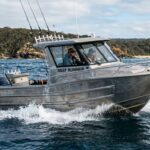
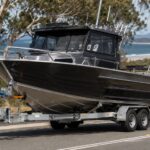
For example, the Sea Raider 7.5m Pro Fisher is a Deep-V mono-hull designed for offshore performance and stability. It uses 5083 marine-grade aluminium plate, with a 6mm bottom, 5mm topsides and 6mm transom. The hull is foam filled and watertight for positive buoyancy, while the 2.45 metre beam and 1.45 metre hull depth provide a substantial offshore platform. It has a maximum person capacity of eight and is available with single or twin outboard configurations depending on the intended setup.
Sea Raider also offers the 6.85m Pro Fisher, which has a 2.45 metre beam, 1.30 metre depth and a maximum person capacity of six. The range extends to larger models for anglers who need additional space and offshore capability.
The important point is that hull selection should match the way you intend to use the boat. Sea Raider’s Deep-V aluminium designs are aimed at anglers who want a plate-built platform for coastal and offshore fishing, rather than a shallow-water-only boat.
Deep V vs Flat Bottom Aluminium Boats: Quick Comparison
| Feature | Deep-V Aluminium Boat | Flat-Bottom Aluminium Boat |
|---|---|---|
| Rough water ride | Excellent | Limited |
| Offshore fishing | Very suitable | Generally unsuitable |
| Shallow water | Limited | Excellent |
| Draft | Deeper | Shallow |
| Stability at rest | Moderate to good | Excellent in calm water |
| Ride comfort | Better in chop | Best on calm water |
| Tracking | Generally good | Good in calm conditions |
| Engine requirements | Usually higher | Usually lower |
| Fuel efficiency | Depends on hull and speed | Often efficient in calm water |
| Best use | Coastal, offshore and rougher water | Rivers, lakes and shallow waterways |
Frequently Asked Questions
Not in every situation. A Deep-V aluminium boat is generally better for rougher water, coastal fishing and offshore use, while a flat-bottom aluminium boat is better for shallow, calm waterways. The best option depends on where you plan to use the boat.
Yes. A Deep-V hull is generally better suited to offshore fishing because its deeper V shape is designed to move through waves and provide a more comfortable ride in chop. However, offshore capability also depends on boat size, freeboard, beam, construction, engine setup and other design factors.
Yes, particularly in shallow and protected waterways. Their shallow draft and stable platform can make them excellent for river, lake and creek fishing where large waves are not normally encountered.
A Deep-V aluminium boat is generally better in rough water than a flat-bottom design. The deeper hull angle helps the boat cut through waves rather than striking them with a broad, relatively flat surface.
A flat-bottom aluminium boat is generally the better choice for shallow water because it has a shallower draft and can access areas where a deeper V hull may run aground.
Flat-bottom boats generally feel more stable when stationary on calm water because of their broad, flat hull surface. Deep-V boats can offer better stability and handling while moving through waves, so “stability” needs to be considered in the context of how and where the boat is being used.
A Modified-V hull sits between a flat-bottom and Deep-V design. It has more deadrise than a flat hull but less than a Deep-V, providing a compromise between shallow-water access, stability and rough-water ride.
They can require more power because the deeper hull can create additional drag and resistance. However, actual fuel consumption depends on many factors, including hull design, boat weight, engine, speed, load, sea conditions and how the boat is operated.
A flat-bottom boat is generally not the preferred choice for exposed offshore conditions. Its hull is better suited to calm, shallow water, and a deeper offshore-oriented hull is normally more appropriate where waves and changing conditions are expected.
Think about where you fish, how often you encounter waves, whether you need shallow-water access, how many people you carry, how much equipment you take, your preferred cruising speed and whether you plan to fish offshore. Your typical operating conditions should guide the hull choice.
Final Thoughts
When comparing Deep V vs Flat Bottom Aluminium Boats, there is no universal winner. Each hull design has been developed around different priorities, and choosing the right one comes down to understanding the water you actually intend to use it in.
A flat-bottom aluminium boat makes a lot of sense for anglers who spend most of their time in shallow, calm waterways. Its shallow draft, efficient operation and stable fishing platform can be exactly what is needed for rivers, lakes, creeks and protected areas.
A Deep-V aluminium boat becomes the more attractive option when the conditions become more demanding. Its deeper hull is designed to provide a smoother ride through chop and better control in larger waves, making it a strong choice for coastal and offshore fishing. The trade-off is additional draft, potentially higher power requirements and less stationary stability compared with a flatter hull.
For many Australian anglers, the decision should ultimately come down to one question: Where will you actually use your boat? If most of your fishing takes place in shallow and protected water, a flat-bottom design may be the smarter choice. If your fishing takes you across open water and offshore, a well-designed Deep-V aluminium boat can provide the capability and ride you need.
Rather than choosing the hull that sounds best on paper, choose the one that matches your local waterways, typical conditions, fishing style and long-term boating plans.
Disclaimer
The information in this article is provided for general informational purposes only and should not be treated as professional boating, safety or regulatory advice. Boat performance and suitability can vary depending on hull design, loading, weather, water conditions, engine configuration and how the vessel is operated.
Always follow the manufacturer’s specifications and applicable Australian boating regulations. Before heading onto open or offshore water, check the weather and sea conditions and make sure your boat, equipment and crew are appropriate for the planned trip.
Last reviewed: September 2026