A good offshore fishing boat should have a hull designed for open-water conditions, strong construction, adequate freeboard, good stability, a practical self-draining cockpit, enough fuel range, reliable outboard power, useful fishing features, weather protection and appropriate safety equipment. For Australian offshore fishing, the right boat also needs to suit the distance you travel, the number of people onboard and the sea conditions you are likely to encounter.
Choosing an offshore fishing boat is about much more than finding a boat with a large engine and plenty of rod holders. Once you leave sheltered water and head into open coastal or offshore conditions, the boat has to do several jobs at the same time. It needs to handle waves, keep people and equipment secure, provide enough space to fish comfortably and have the range and reliability to get you home.
Australian waters can be particularly demanding. Conditions can change during a fishing trip, and the sea state you encounter on the way home may be very different from what you experienced when leaving the ramp. That is why hull design, stability, freeboard, construction and safety features deserve just as much attention as the fishing equipment.
So, what should you actually look for when comparing offshore fishing boats?
Here are 10 important features to consider.
1. A Hull Designed for Offshore Conditions
The hull is the foundation of any offshore fishing boat. It affects how the boat behaves when travelling into waves, crossing swell, running with the sea and drifting over a fishing spot.
For many offshore applications, a Deep-V hull is a popular choice because the sharper entry can help the boat move through chop and swell more comfortably than a flatter hull. Hull design also influences tracking, fuel consumption, stability and how the boat behaves at different speeds.
However, there is no single hull shape that is perfect for every fishing situation. A boat intended for sheltered rivers will have different requirements from one designed for regular offshore fishing.
When comparing boats, look beyond the name of the hull design. Consider the overall hull shape, beam, depth, deadrise, weight and how the different elements work together.
A good offshore boat should feel controlled rather than harsh when travelling through ordinary coastal chop. It should also provide enough stability when you slow down, drift or stop to fish.
The hull should match the water you actually intend to fish, rather than simply being selected because a particular hull style is popular.
2. Strong and Well-Designed Construction
Offshore fishing puts considerable demands on a boat. The hull and structure have to cope with repeated impacts from waves, equipment, passengers and the general punishment that comes with regular saltwater use.
This makes construction quality one of the most important things to investigate.
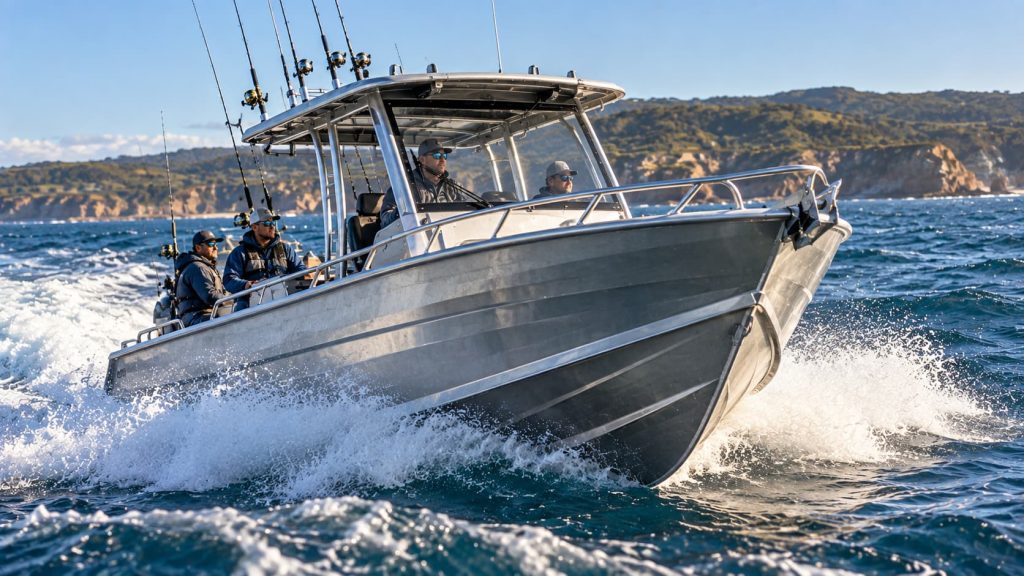
For aluminium boats, don’t judge quality purely by plate thickness. The alloy, welding, internal structure, stringers, ribs, transom construction, floor and overall hull design all contribute to the finished boat.
A thicker plate may sound impressive on a specification sheet, but it is only one part of the picture. The way the hull is engineered and assembled matters just as much.
A properly constructed plate aluminium boat can offer a strong platform for offshore fishing while also providing practical advantages for Australian boat owners, including durability and relatively straightforward maintenance.
When inspecting a boat, look at the quality of the welds, the structure underneath the floor, the transom, drainage arrangements and how the major components are supported.
The goal is not simply to find the heaviest boat. It is to find a boat where the construction has been designed around the conditions in which it will be used.
3. Adequate Freeboard and Hull Depth
Freeboard is the distance between the waterline and the upper edge of the hull. It is an important consideration when choosing an offshore fishing boat because higher sides can provide greater separation between the occupants and the surrounding water.
When offshore, waves can approach the boat from different directions. A wave coming across the side or following behind the boat can put water into the cockpit if the boat has insufficient freeboard or poor deck drainage.
Freeboard also becomes important when people are moving around the boat while fishing. Anglers may be leaning over the side, fighting fish or moving quickly from one part of the cockpit to another.
Australian coastal fishing guidance recommends paying close attention to cockpit freeboard, hull seaworthiness and the ability of the boat to deal with changing conditions.
At the same time, more freeboard is not automatically better in every situation. A boat is a complete design, and hull height needs to work with beam, weight, centre of gravity and overall stability.
When comparing offshore fishing boats, look at the boat as a complete package rather than focusing on one measurement.
4. Good Stability
Stability is one of the most important characteristics of an offshore fishing boat.
A fishing boat does not spend its entire life travelling at speed. Much of the day may be spent drifting, trolling, anchoring or moving slowly around a fishing location. During these situations, people are constantly changing position and equipment may be moved around the cockpit.
A stable fishing platform makes these activities more comfortable and predictable.
Stability is also affected by how the boat is loaded. Passengers, fuel, batteries, ice, fishing equipment and catch all add weight. Poor weight distribution can affect how the boat sits and behaves.
The Australian Maritime Safety Authority highlights overloading, shifting equipment, modifications, water on deck and changing weather conditions as factors that can affect vessel stability.
This is why the maximum capacity and loading information supplied for a boat should always be respected.
When buying an offshore fishing boat, ask how the boat behaves both underway and at rest. If possible, experience the boat on the water with a realistic load rather than judging stability only while it is sitting on a trailer.
5. A Practical Self-Draining Cockpit
Fishing is a wet activity. Water can come aboard through spray, rain, waves, fish handling, washdown and general boat use.
A good offshore fishing boat needs an effective way of getting that water back overboard.
A self-draining cockpit can be particularly valuable offshore because water needs to leave the deck efficiently rather than accumulating around passengers and equipment.
The drainage system should be designed properly and kept clear during use. Scuppers, drains, bilge pumps and other components all have a role to play.
This is particularly important if a wave comes over the side or stern. The boat should be designed to deal with water on deck rather than relying on the crew to manually remove it.
Australian maritime guidance also identifies water on deck, swamping and flooding as important stability considerations.
When inspecting a boat, don’t simply ask whether it has a self-draining deck. Look at how the system works, where the drains are positioned and whether water can flow freely when the boat is loaded.
6. Enough Fuel Capacity and Offshore Range
Fuel capacity becomes much more important once you start travelling further from shore.
An offshore fishing trip may involve a long run from the ramp to the fishing grounds, time spent searching for fish, trolling or moving between locations, followed by the journey back.
The boat therefore needs enough usable range for the trip rather than just enough fuel to reach the fishing location.
Weather can also change your plans. You may need to return earlier, travel further than expected or alter your route.
Fuel capacity should therefore be considered alongside engine efficiency, cruising speed, hull weight and the distances you normally travel.
For example, Sea Raider’s 7.5m Pro Fisher has a published 350-litre fuel capacity, giving the boat a substantial fuel reserve for offshore-oriented use. Its specifications also include 250 to 350hp single or twin outboard configurations.
The important point is not to choose a tank simply because it is large. The tank, engine and hull should work together to provide a practical cruising range for your intended trips.
7. Reliable and Appropriately Sized Outboard Power
A good offshore fishing boat needs dependable propulsion.
The engine has to move the boat efficiently when conditions are calm, but it also needs enough power to deal with changing conditions, passengers, fuel and fishing equipment.
Choosing the largest engine available is not necessarily the answer. The engine should be appropriate for the hull and within the manufacturer’s specified power range.
Reliability is particularly important offshore because an engine problem several kilometres from the coast is very different from an engine problem on a calm inland lake.
Some larger offshore boats can also be configured with twin outboards. This can provide additional propulsion flexibility and is one reason some offshore buyers prefer a twin-engine setup.
The choice between single and twin engines depends on the boat, intended use, budget, maintenance requirements and manufacturer’s specifications.
When comparing boats, look at the complete propulsion package rather than focusing only on maximum horsepower.
8. A Fishing-Friendly Cockpit and Deck Layout
An offshore fishing boat should be designed around the people actually using it.
Think about what happens when several anglers are onboard. Someone may be casting, another person may be fighting a fish, another may be preparing bait and someone else may need to move from the bow to the stern.
A good layout allows people to move without constantly stepping over seats, tackle boxes and fishing equipment.
Useful features can include:
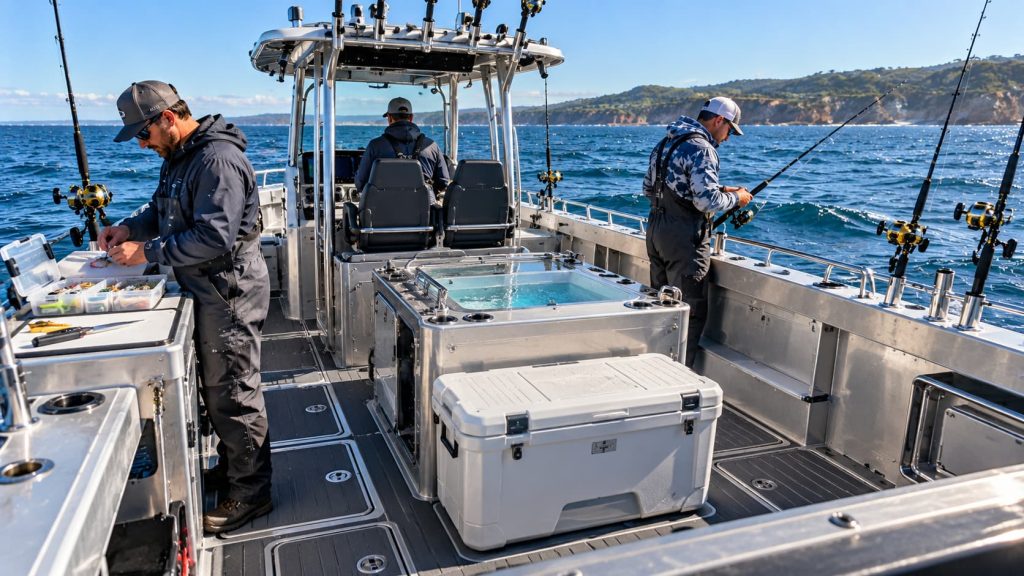
- Plenty of rod holders
- Convenient tackle storage
- Fish boxes or underfloor storage
- Live bait tank
- Cutting board or bait preparation area
- Clear walkways
- Secure handholds
- Non-slip flooring
- Practical transom access
- Easy access around the cockpit
The layout should also suit the type of fishing you do.
A boat designed for chasing pelagic fish offshore may need a different cockpit arrangement from one primarily used for reef fishing or family trips.
The key question is simple: Can you actually fish comfortably from the boat?
A boat can have an impressive list of specifications and still be frustrating if the cockpit is cramped or poorly arranged.
9. Protection From Weather and Spray
Offshore fishing can involve long periods on the water, so protection from sun, wind, rain and spray is another feature worth considering.
A centre console with a hardtop, cabin or enclosed driving position can make a significant difference when travelling offshore.
Weather protection is not simply about comfort. It can also help the skipper maintain visibility and stay focused when conditions become unpleasant.
Australian coastal boating advice recommends considering protection from the sun as well as protection from spray and changing weather.
The right configuration depends on how and where you fish.
If you usually make short offshore trips in warm weather, an open centre console may suit you perfectly. If you regularly travel further offshore or fish throughout the year, additional shelter may become much more important.
Consider the helm position, windscreen, hardtop, seating, visibility and access to controls before making a decision.
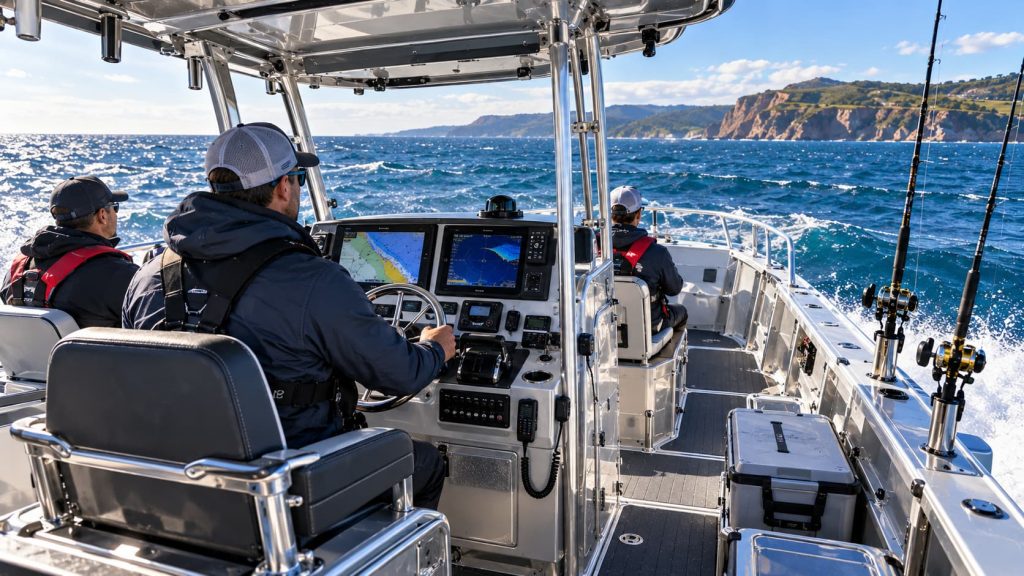
10. Proper Safety and Navigation Equipment
A capable hull is important, but no boat should be treated as a substitute for preparation and safety equipment.
Offshore anglers should consider the equipment required for their location, vessel and intended trip. Depending on the boat and operating area, this can include navigation equipment, communication equipment, lights, sounders, GPS, appropriate lifejackets, bilge pumps, emergency equipment and other required safety gear.
Navigation and communication equipment can become particularly important when visibility deteriorates or you are operating away from familiar waters.
It is also worth considering redundancy where appropriate. For example, having backup communication options or essential equipment can provide additional resilience when something fails.
The exact equipment requirements vary depending on the state or territory, vessel type and operating conditions, so always check the current requirements that apply to your boat and location.
Safety should be considered before the trip rather than after the boat is already on the water.
What Other Features Should You Look For?
The 10 features above are the major areas to consider, but there are several smaller details that can make a big difference to the ownership experience.
Look at how easy the boat is to wash down after saltwater use. Check whether the bilge and pumps are easy to access. Look at battery access, wiring, switches and electrical protection. Think about where wet gear will be stored and whether there is enough space for the equipment you actually carry.
You should also consider the trailer if you are buying a trailer boat. The boat may be excellent offshore, but towing a heavy rig requires an appropriate trailer and tow vehicle.
Think about maintenance as well. A boat that is easy to inspect, clean and service is likely to be much easier to live with over the long term.
What Makes a Good Offshore Fishing Boat for Australian Conditions?
There is no single boat that is perfect for every Australian angler.
Someone fishing sheltered coastal water close to a harbour may have very different requirements from someone travelling much further offshore for long fishing sessions.
The most important thing is to match the boat to the conditions and distances you genuinely expect to encounter.
For offshore use, the combination of hull design, construction, freeboard, stability, drainage, fuel range and safety equipment becomes particularly important.
Australian offshore boating guidance also stresses the importance of considering weather and sea conditions before heading out. A boat should be capable of handling the conditions you may reasonably encounter, but the skipper still needs to make sensible decisions about whether to go and when to return.
Offshore Fishing Boats From Sea Raider
Sea Raider builds plate aluminium boats designed around fishing and Australian boating conditions. Its offshore-focused range includes the Pro Fisher models, which combine plate construction with features intended for longer fishing trips.
The 7.5m Pro Fisher is a good example. It is a Deep-V mono-hull with a 2.45m beam and 1.45m depth. The hull uses 5083 marine-grade aluminium with 6mm bottom plate, 5mm topsides and a 6mm transom. It is also foam filled and watertight, with a self-draining deck and bilge pump.
From a fishing perspective, the standard equipment includes a 45-litre live bait tank, gunwale rod holders, rocket launchers, cutting board, side storage trays and other practical fishing features. The boat has a published maximum capacity of eight people and a 350-litre fuel tank.
These specifications illustrate an important point when comparing offshore fishing boats. The best choice is not simply the boat with the biggest engine or thickest plate. You need to consider how the hull, structure, fuel capacity, fishing layout, drainage and safety features work together.
Quick Checklist: What to Look For in an Offshore Fishing Boat
Before buying, ask yourself:
- Is the hull designed for the conditions where I intend to fish?
- Is the construction strong enough for regular offshore use?
- Does the boat have adequate freeboard?
- How stable is it when stationary and underway?
- Does the cockpit drain effectively?
- Does the fuel capacity provide enough range for my normal trips?
- Is the engine appropriately sized and reliable?
- Is there enough room for my fishing crew and equipment?
- Is there adequate protection from sun, wind and spray?
- Does the boat have the safety and navigation equipment I need?
If you can answer these questions confidently, you will have a much clearer idea of whether a boat is actually suitable for your type of offshore fishing.
FAQs About Offshore Fishing Boats
A boat with a hull designed for open-water conditions, good stability, adequate freeboard, strong construction, reliable power and suitable weather protection is generally well suited to offshore fishing. The ideal hull and layout depend on the conditions, distance and type of fishing.
A Deep-V hull can be well suited to offshore fishing because its deeper hull angle can help it travel through waves and chop more comfortably. However, hull design should always be considered alongside beam, weight, freeboard, stability and the overall construction of the boat.
There is no single correct size. The appropriate size depends on how far offshore you travel, the number of people onboard, the conditions you expect and the type of fishing you do. Larger boats generally provide more space and capability, but they also cost more to purchase, tow, maintain and operate.
There is no universal freeboard measurement that makes a boat automatically suitable for offshore fishing. What matters is whether the hull provides appropriate protection from waves and spray while maintaining suitable stability and handling characteristics.
A self-draining deck can be an important feature for offshore fishing because it allows water that comes aboard to drain away rather than accumulating in the cockpit. The drainage system still needs to be properly maintained and kept clear.
Fuel requirements depend on the boat, engine, cruising speed, distance, weather and fishing style. Calculate the expected fuel consumption for the entire trip and allow an appropriate reserve rather than basing the decision only on the distance to the fishing grounds.
Useful features can include rod holders, live bait tanks, fish boxes, tackle storage, cutting boards, non-slip flooring, washdown systems and an open cockpit with enough room to move around. The best combination depends on the type of fishing you do.
Marine-grade aluminium can be well suited to offshore fishing when the hull is properly designed and constructed. Plate aluminium boats can provide a strong and practical platform, but the quality of the alloy, welding, internal structure, hull design and overall construction all matter.
Pay attention to how the boat accelerates, turns, handles chop, tracks at cruising speed and behaves when slowing down. Check visibility from the helm, cockpit movement, stability at rest and how easy it is to move around while fishing.
There is no single feature that determines whether a boat is suitable for offshore fishing. Hull design, construction, stability, freeboard, drainage, fuel range, propulsion, fishing layout and safety equipment all work together. The boat should ultimately be matched to the conditions and type of offshore fishing you intend to do.
Final Thoughts
A good offshore fishing boat should be more than a fishing platform with a powerful engine. It needs to be designed as a complete system that can handle the demands of open water while giving anglers enough space and equipment to fish effectively.
Start with the fundamentals. Look at the hull, construction, freeboard and stability before getting distracted by optional accessories. Then consider fuel range, engine setup, cockpit layout, fishing features, weather protection and safety equipment.
Most importantly, choose a boat based on where you actually intend to fish. A boat that works brilliantly in sheltered coastal water may not be the right choice for regular offshore trips into larger swell and changing weather.
The right offshore fishing boat is ultimately one that gives you the combination of capability, practicality, range and safety that matches your own fishing plans.
Disclaimer: This article is provided for general informational purposes only. Boat specifications, safety requirements and operating regulations can vary depending on the vessel, location and intended use. Always check the current requirements that apply to your boat and the waters where you intend to operate, and follow the manufacturer’s specifications and relevant Australian marine safety requirements.