What is a double chine hull and how does it improve boat performance?
A double chine hull has two distinct chine lines along each side of the hull, creating multiple changes in angle between the bottom and sides. This shape can improve stability, generate additional lift when the boat gets onto the plane, help control spray and provide more predictable handling in turns. On an aluminium fishing boat, a well-designed double chine hull can combine offshore stability, practical fishing space and efficient planing performance. The actual result depends on the complete hull design, including the deadrise, beam, weight distribution, chine angles and running surface.
When people compare fishing boats, they often concentrate on the engine, length, plate thickness or the amount of fishing equipment onboard. The hull itself can receive much less attention, even though it has a major influence on how the boat behaves on the water.
One design feature worth understanding is the double chine hull.
You may have seen the term in aluminium boat specifications without knowing exactly what it means. A chine is essentially a change in angle along the hull where one surface transitions into another. In a double chine design, the hull uses two distinct chine lines rather than relying on a single major transition.
That extra change in hull shape is not simply there for appearance. Depending on how the hull has been designed, the chines can influence lift, spray, stability, handling and the way water moves away from the boat.
For fishing boats that need to work across a mixture of conditions, these characteristics can be particularly useful.
What Is a Chine on a Boat?
Before looking at a double chine hull, it helps to understand what a chine actually is.
A chine is the area or edge where the bottom of a boat’s hull changes direction as it moves towards the sides. On a hard-chined aluminium boat, this change can be clearly defined rather than smoothly curved.
The position, width and angle of a chine influence the way water flows around the hull. A chine can help create lift at speed, redirect spray away from the boat and contribute to stability.
Chines are particularly important on planing boats because the hull needs to interact with the water in a controlled way as speed increases. The outer parts of the hull can contribute to lift and stability while also influencing how water separates from the running surface.
What Is a Double Chine Hull?
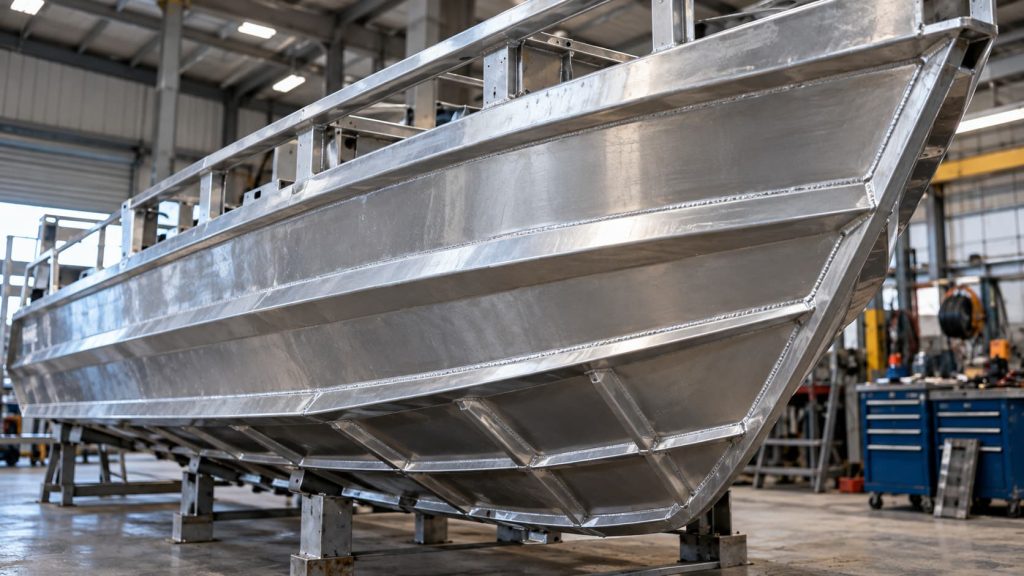
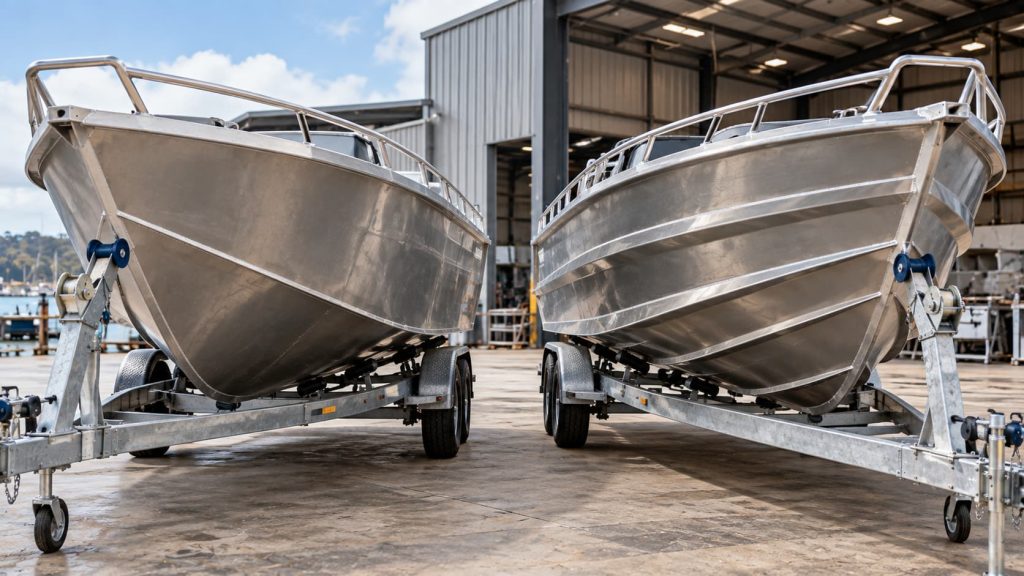
A double chine hull uses two distinct chine transitions along each side of the hull.
Instead of having one main change between the bottom and topside, the cross-section is divided into additional surfaces. This creates a more stepped or multi-angle hull shape.
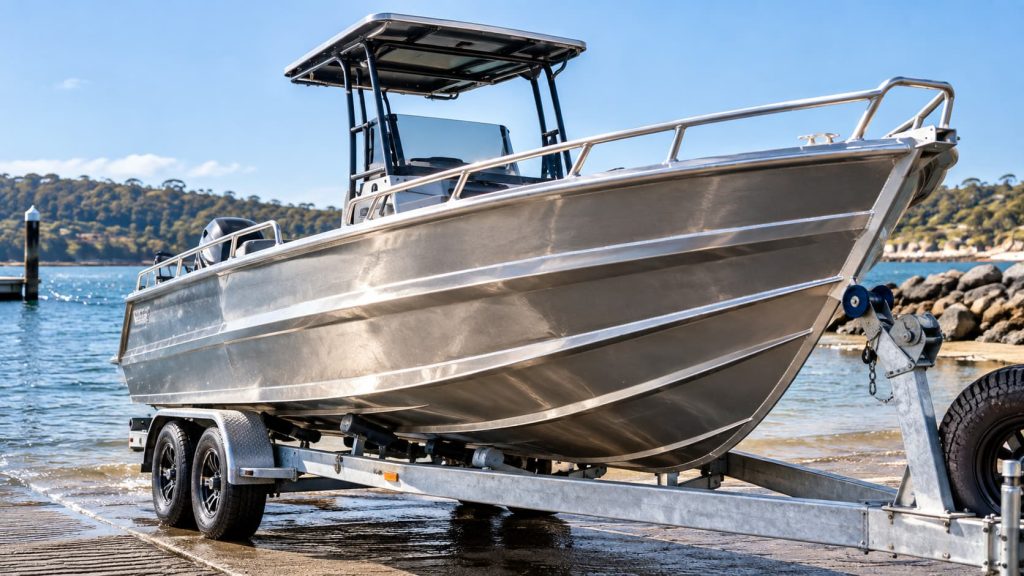
Sea Raider describes its double chine hull as using three main surfaces across the hull section: the bottom and two angled sides. According to the manufacturer’s description, the design is intended to direct spray away from the boat, generate lift as the hull gets onto the plane and provide additional support during turns.
The exact shape of a double chine varies between hull designs. Chine width, angle, position and the relationship between the chines and the deadrise all matter.
That means two boats can both be described as having double chine hulls while behaving differently on the water.
The important point is that double chine is a hull design feature, not a guarantee of a particular level of performance. The entire hull needs to work together.
How Does a Double Chine Hull Improve Boat Performance?
The biggest potential benefits come from the way the additional chine surfaces interact with the water.
A well-designed double chine hull can influence several areas of performance at the same time, including stability, lift, spray control and handling.
Let’s look at each one.
1. Improved Stability
Stability is one of the major reasons chines are used in modern planing hulls.
The outer chine sits towards the edge of the hull, where it can have a significant influence on how the boat reacts when it rolls or heels. As the boat leans, the underwater shape changes and the chine can provide additional support.
This can be useful when passengers are moving around the boat, when anglers are fishing from different positions or when the boat is turning.
Chines can also contribute to stability while the boat is moving. The exact effect depends on the hull’s beam, deadrise, weight and chine geometry, but the additional hull surfaces can help create a more settled platform.
For a fishing boat, this matters because stability is not just about comfort. Anglers need to move around the cockpit, handle fishing gear and sometimes fight a fish from an awkward position.
A stable hull can make those activities easier and more predictable.
2. More Lift When Getting Onto the Plane
A planing boat needs to generate enough hydrodynamic lift to rise onto the water rather than pushing through it entirely at displacement speeds.
The chines can contribute to that lift.
As speed increases, water flows across the hull and interacts with the chine surfaces. The geometry can help produce additional dynamic lift, allowing the boat to rise onto the plane.
This is one reason chines are common on planing fishing boats. They can help support the hull at speed and influence how quickly and efficiently the boat transitions from slower running to planing speed.
A double chine configuration gives the designer additional surfaces with which to manage this interaction.
However, it is important not to assume that adding another chine automatically makes a boat faster. Hull performance depends on many factors, including hull weight, engine power, deadrise, beam, trim and the shape of the running surface.
The advantage comes from how those elements are engineered together.
3. Better Spray Control
Anyone who has spent time in a small fishing boat knows that spray can quickly become annoying.
At speed, water moves away from the hull. If that water is not directed properly, spray can reach the cockpit, passengers and helm.
One function of a chine is to redirect water away from the hull.
A properly designed chine can help push spray outward and downward, reducing the amount of water travelling towards the boat’s occupants. Sea Raider specifically describes its double chine configuration as directing spray outward and down.
This can make a noticeable difference when travelling through chop or crossing waves.
It is also important to distinguish chines from spray rails. Spray rails are smaller longitudinal features that can also help separate water from the hull and reduce spray. Both features can be used together as part of a complete hull design.
4. A Drier Ride
Spray control has a direct connection with comfort.
A boat that constantly throws spray into the cockpit can make even a moderate trip unpleasant. Passengers get wet, fishing equipment becomes harder to manage and the helm becomes less comfortable.
By redirecting water away from the hull, the chines can contribute to a drier ride.
This does not mean a double chine hull will always stay completely dry. Wind direction, wave direction, boat speed, trim and hull design all influence how much spray reaches the boat.
Still, controlling water flow is an important part of designing a comfortable fishing boat.
For Australian fishing, where boats may operate in wind-against-tide conditions, crossing bars or travelling through coastal chop, controlling spray can be particularly useful.
5. Better Handling in Turns
A good fishing boat needs to do more than travel in a straight line.
When the boat turns, it heels and the underwater shape changes. The chines can influence the amount of support generated on the outside of the hull.
This can help the boat feel more controlled through a turn.
The effect depends heavily on the shape and angle of the chine. A designer needs to balance stability, grip, ride quality and impact loads rather than simply making the chine as large as possible.
Chines can also influence how the boat tracks and responds when changing direction. Their effect becomes part of the overall relationship between the hull, water flow and steering system.
For an offshore fishing boat, predictable handling is particularly valuable because conditions are rarely perfectly uniform.
6. Useful Performance at Planing Speeds
A major advantage of a well-designed planing hull is the ability to travel efficiently once it reaches its intended cruising speed.
The chines can help separate water from parts of the hull and contribute to the lifting surfaces supporting the boat.
Research into double chine hull forms has found that the configuration can provide hydrodynamic advantages under particular operating conditions. For example, marine hull-design research has identified potential reductions in resistance associated with double chine configurations, although the result varies with hull geometry and operating speed.
This is an important distinction.
A double chine does not automatically mean lower fuel consumption or higher speed. Instead, it gives the designer another way to control the underwater shape and water flow.
The final result depends on how successfully the complete hull has been designed.
7. A Good Balance Between Stability and Ride
Boat design is always about compromises.
A hull that is extremely stable at rest may not provide the same ride characteristics as a hull designed primarily to cut through waves. Likewise, a very deep-V hull may provide a softer ride in rough water but require more power and may behave differently at rest.
Chines can help designers find a balance between these characteristics.
The outer chine can add support and dynamic lift without requiring the entire hull bottom to be made flat. This allows a boat to retain a more pronounced deadrise while still gaining some of the benefits associated with additional hull surfaces.
That balance can be valuable for offshore fishing boats, where the boat needs to behave reasonably well both while travelling and while sitting on a fishing spot.
Double Chine vs Single Chine Hull
The difference between a single chine and double chine hull is easiest to understand by looking at the number of major transitions across the hull section.
A single chine has one primary chine on each side.
A double chine introduces another significant transition, creating additional hull surfaces.
This gives the designer more control over the underwater shape and how water moves around it.
A single chine can still be an excellent hull design. There is no rule that a double chine boat will outperform every single chine boat.
The quality of the complete hull design is more important than simply counting the chines.
When comparing two boats, look at the hull as a whole. Consider deadrise, beam, weight, freeboard, bottom shape, chine angles, engine setup and the intended operating conditions.
Does a Double Chine Hull Make an Aluminium Boat More Stable?
It can contribute to stability, particularly when the hull is moving and the chines are interacting with the water.
The chines extend towards the outer edges of the hull and can provide additional support as the boat heels. They can also contribute to dynamic lift and help control the hull during turns.
However, hull stability is not determined by the chines alone.
Beam, weight distribution, centre of gravity, deadrise, hull depth and loading all matter. The number of people onboard and where they are positioned can also affect how a boat behaves.
This is why a wider boat is not automatically a better boat, and a double chine is not automatically a guarantee of stability.
Does a Double Chine Hull Improve Offshore Performance?
It can, depending on the complete hull design.
Offshore boats need to deal with waves arriving from different directions, changing wind conditions and varying loads. A hull that can maintain predictable handling while travelling through chop is valuable.
A double chine can help manage spray, contribute to dynamic stability and provide additional lifting surfaces.
Sea Raider specifically positions its double chine hull as part of its offshore-oriented aluminium boat design, with the chines intended to direct water downwards and contribute to stability.
But offshore capability should never be judged from the chine configuration alone.
The bow shape, deadrise, freeboard, beam, hull weight, transom, deck drainage and overall construction all contribute to how an offshore boat performs.
Does a Double Chine Hull Use More Fuel?
Not necessarily.
Fuel consumption depends on the entire boat, including hull weight, engine size, propeller, cruising speed, load and water conditions.
The additional hull surfaces created by a double chine can influence resistance and water flow, but that does not mean every double chine boat will automatically be more economical.
Hydrodynamic studies show that resistance can vary depending on the specific hull form and operating speed.
This is why real-world fuel consumption figures are more useful than trying to predict efficiency from one hull feature alone.
Why Double Chine Hulls Work Well for Aluminium Boats
Aluminium is widely used for fishing boats because it lends itself well to hard-chined hull construction.
Flat aluminium plate can be cut, formed and welded into carefully designed hull sections. Multiple flat surfaces can create complex hull shapes without requiring the curved moulds associated with some other construction methods.
A double chine design can therefore work naturally with plate aluminium construction.
Sea Raider uses marine-grade DNV-5083 aluminium across its range and incorporates double chine hull design as one of its performance features.
The combination can create a practical hull with substantial internal volume, defined running surfaces and a structure suited to the demands of fishing.
Of course, the construction quality remains critical. The alloy, welding, internal framing, transom and overall engineering need to work together.
Double Chine Hulls From Sea Raider
Sea Raider uses a double chine hull design across its aluminium plate boat range.
The company’s hull information describes the double chine as a three-surface arrangement consisting of the bottom and two angled sides. The design is intended to direct spray away from the boat, create additional lift as the hull gets onto the plane and provide support when turning.
Sea Raider also highlights the relationship between hull design and offshore stability, with beam and trim control forming part of the overall approach to ride and stability. Its range uses marine-grade DNV-5083 aluminium, with different models built around different hull sizes and configurations.
This is a useful example of why hull design should be considered as a complete package.
The double chine is not working independently. It forms part of the boat’s overall hull geometry, construction, weight distribution and intended use.
What Should You Look For When Buying a Double Chine Aluminium Boat?
If you are considering a double chine aluminium boat, don’t stop at the specification sheet.
Ask how the boat behaves on the water.
Look at how quickly it gets onto the plane, how it handles turns, whether spray is controlled, how stable it feels at rest and how it behaves through ordinary chop.
It is also worth looking at:
- Hull plate thickness
- Marine-grade aluminium alloy
- Deadrise
- Beam
- Freeboard
- Transom construction
- Internal framing
- Cockpit drainage
- Engine options
- Fuel capacity
- Maximum passenger capacity
- Trailer weight
- Intended operating conditions
A proper sea trial can tell you things that a brochure cannot.
Pay particular attention to the boat when it is loaded realistically. A boat with one person and a nearly empty fuel tank can behave very differently from the same boat carrying several anglers, full fuel, batteries, fishing gear and a day’s catch.
Is a Double Chine Hull Right for You?
A double chine hull can be an attractive choice if you want a fishing boat that combines stability, spray control, planing performance and predictable handling.
It is particularly relevant when looking at aluminium fishing boats designed for coastal and offshore use.
But don’t choose a boat solely because it has a double chine.
Think about where you fish, how many people you normally carry, how far offshore you travel and the conditions you expect to encounter.
Then look at the entire hull.
The best boat is not necessarily the one with the most complicated hull shape. It is the one where the hull design, construction, engine, weight, layout and equipment all work together for the conditions you actually intend to face.
Frequently Asked Questions
A double chine hull has two distinct chine transitions along each side of the hull. These create additional angled surfaces between the bottom and upper sides of the boat, influencing lift, stability, spray control and handling.
A chine changes the way water flows around the hull. Depending on its position and shape, it can contribute to lift, stability, spray deflection and handling, particularly when the boat is travelling at planing speeds.
Neither is automatically better. A double chine gives the designer additional control over hull geometry and water flow, but the performance of the finished boat depends on the entire hull design, including deadrise, beam, weight and chine geometry.
A well-designed double chine aluminium boat can be well suited to offshore fishing. The design can contribute to stability, spray control and planing performance. However, offshore suitability also depends on freeboard, hull depth, construction, drainage, propulsion and the boat’s overall design.
It can contribute to both static and dynamic stability. The chines provide additional hull surface towards the outer edges, which can help support the boat as it heels. Overall stability is also affected by beam, weight distribution, deadrise and loading.
It can contribute to a more controlled and comfortable ride by helping manage spray, lift and water flow. However, ride quality depends on the entire hull, particularly the bow shape, deadrise, weight and running surface.
Not necessarily. Chines can contribute to lift and influence resistance, but speed depends on many factors including hull weight, engine power, propeller, trim, deadrise and hull geometry.
One of the functions of a properly designed chine is to redirect water away from the hull. A double chine can provide additional surfaces for managing water flow and spray. Wind and sea conditions will still affect how dry a boat feels.
A properly designed double chine hull can be suitable for coastal and offshore Australian conditions, but the chine itself does not determine seaworthiness. The complete hull, construction, freeboard, stability, drainage and operating limits need to be considered.
They describe different aspects of hull design. A Deep-V refers primarily to the angle of the hull bottom, known as deadrise. A double chine describes the number and arrangement of chine transitions. A boat can therefore have a Deep-V hull and also incorporate a double chine design.
Final Thoughts
A double chine hull is more than a styling feature. It is a deliberate part of hull design that changes how a boat interacts with the water.
By creating additional hull surfaces, the chines can contribute to lift, stability, spray control and handling. These characteristics can be particularly useful on aluminium fishing boats that need to perform across a range of speeds and conditions.
The key is to look at the complete boat rather than one specification.
A well-designed double chine combined with suitable deadrise, adequate beam, strong construction and appropriate engine power can create a capable fishing platform. For offshore use, that design also needs to be supported by sufficient freeboard, drainage, fuel range and sensible loading.
If you are comparing aluminium fishing boats, understanding the hull is one of the best ways to move beyond a list of specifications and understand how the boat is actually intended to perform.
Disclaimer: This article is provided for general informational purposes only. Boat performance varies according to hull design, loading, engine setup, weather, sea conditions and other factors. Always follow the manufacturer’s specifications and operating limits and assess conditions before heading offshore.