How do you inspect a used aluminium boat before buying?
To inspect a used aluminium boat, check the hull for dents, corrosion, cracked welds and signs of previous repairs. Examine the transom, engine, steering, electrical systems, fuel system, safety equipment and trailer. Ask for maintenance records, verify the boat’s identification and registration details, and arrange a sea trial before committing to the purchase. For older, expensive or offshore fishing boats, an independent marine survey and professional engine inspection can help identify problems that are not obvious during a visual check.
Buying a used aluminium boat can be a practical way to get out on the water without paying the price of a new model. A well-maintained boat may have plenty of fishing trips left in it, but a low asking price does not always mean you are getting a good deal.
The challenge is knowing what to look for. A boat might have a clean interior, polished hull and recently serviced outboard while still hiding corrosion, structural damage or neglected electrical components. Repairs to the hull, motor or trailer can quickly change the overall cost of ownership.
If you are considering a second-hand aluminium fishing boat in Australia, take your time and inspect the complete package before making an offer. This guide explains the main checks to carry out, the warning signs to watch for and when to bring in a professional.
1. Start With the Boat’s History and Paperwork
Before inspecting the boat itself, ask the seller about its age, ownership history, previous use and maintenance. Find out whether it has mainly been used in freshwater, coastal waters or offshore conditions. Saltwater use is not necessarily a problem, but it makes regular cleaning, corrosion prevention and maintenance particularly important.
Ask whether the boat has been involved in a collision, run aground, repaired after taking on water or modified since it was built. If the seller mentions repairs, request photographs, invoices and details of the work completed. Missing records do not automatically make a boat unsuitable, but they leave more questions to answer.
Check that the hull identification number (HIN) matches the details on the relevant paperwork. Verify the registration status with the appropriate state or territory maritime authority, and confirm that the seller has the right to sell the vessel.
It is also worth conducting a Personal Property Securities Register (PPSR) search immediately before buying. A watercraft search can identify registered security interests that may indicate money is still owing on the boat. If a trailer is included, search it separately using its vehicle identification number (VIN), where applicable, because a watercraft search does not cover the trailer.
2. Inspect the Aluminium Hull Carefully
The hull should be one of your first priorities when inspecting a used aluminium boat. Cosmetic marks are common on fishing boats, particularly those regularly launched from ramps or used around rocky shorelines. The important distinction is between ordinary wear and damage that could affect the boat’s structural integrity.
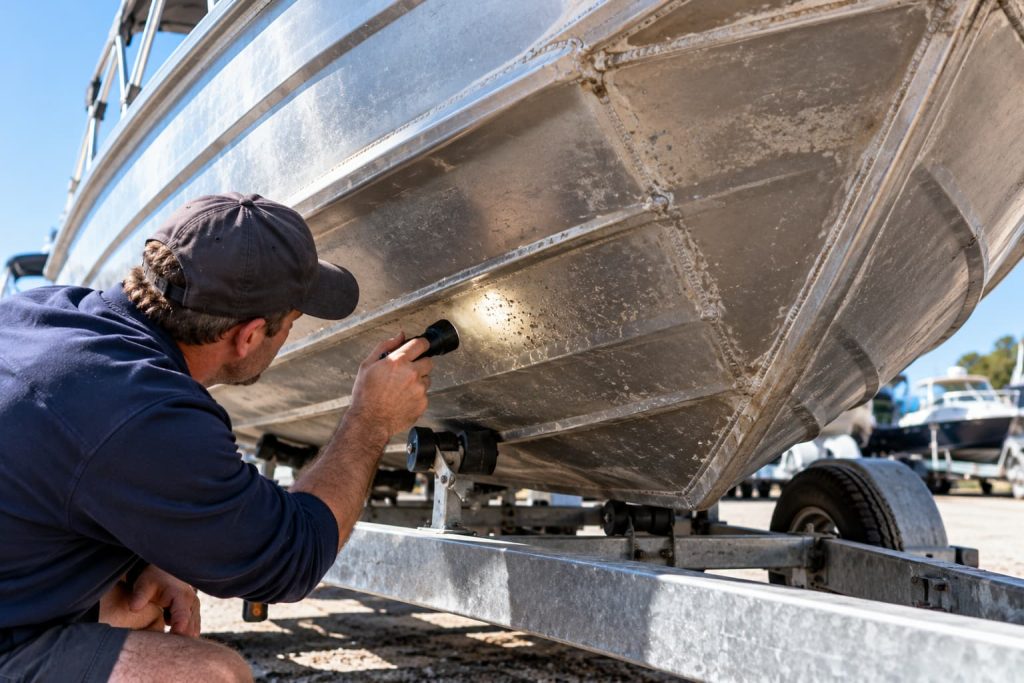
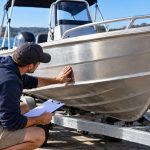
If possible, inspect the boat while it is out of the water and supported safely on a suitable trailer or cradle. Walk around the outside and look along the hull from different angles. Uneven surfaces, pronounced dents, creases or distorted panels may indicate impact damage. Pay particular attention to the keel, chines, bow and lower sections of the hull, which can take a beating during launching, beaching and offshore use.
Small scratches and shallow dents are not necessarily reasons to walk away. However, deep creases, splits, holes or evidence of substantial deformation deserve closer investigation. Ask the seller how the damage occurred and whether it has been assessed or repaired professionally.
Look for signs of corrosion, including pitting, unusual white or powdery deposits, damaged coatings and localised deterioration around fittings. Aluminium naturally forms a protective oxide layer, so a dull surface alone does not mean the hull is failing. Deep pitting or material loss is a different matter and should be assessed by someone experienced with aluminium boats.
Check for Electrolysis and Galvanic Corrosion
Aluminium boats can develop corrosion where dissimilar metals come into contact in the presence of an electrolyte, such as saltwater. Electrical faults can also contribute to corrosion. Inspect areas around bolts, screws, brackets, transducer mounts, anodes and other metal fittings.
Pay attention to the bilge and other areas where water, salt and debris may collect. Corrosion around trailer rollers or skids is also worth checking, especially if the boat has spent long periods sitting on the trailer without being rinsed or moved.
Surface discolouration may be manageable, but deep pitting, perforation or corrosion around structural connections needs professional attention. Do not assume that a fresh coat of paint or sealant has resolved the underlying problem.
3. Look Closely at Welds, Chines and the Transom
Welds are critical to the strength of a welded aluminium hull. Inspect accessible welds around the keel, chines, frames, ribs, transom brackets and other structural connections. Look for visible cracks, separation, unusual distortion or signs of previous patching.
A repaired weld is not automatically a bad sign. Aluminium boats can be repaired successfully, provided the work is appropriate for the damage and carried out properly. Ask who completed the repair, what caused the original problem and whether supporting documentation is available.
The chines deserve particular attention because they form important parts of the hull structure and can experience repeated loading. Cracks near the chines, keel or frame connections should not be dismissed as ordinary wear.
Next, inspect the transom, where the outboard motor is mounted. Look for cracks around engine mounting points, loose brackets, distorted metal, corrosion and movement between connected components. Check the transom from inside the boat as well as from the outside.
If you notice cracked welds, significant distortion or signs that the engine mounting area has moved, arrange an independent inspection before proceeding. Structural repairs can be costly, and the condition of these areas affects both reliability and safety.
4. Inspect the Floor, Deck and Interior
A boat can look tidy from the outside while showing signs of neglect inside. Walk carefully around the deck and cockpit, paying attention to loose panels, unusual movement, damaged fittings and areas where water appears to collect.
On an aluminium boat, check the floor supports, internal ribs, bulkheads and accessible structural connections. Look for corrosion beneath removable hatches and around the bilge, where debris and moisture may have accumulated. Inspect storage compartments for standing water, strong fuel smells, damaged wiring or evidence of poor repairs.
Test the seats, hatches, doors, rails, cleats and other fittings. They should be secure and suitable for their intended use. Loose fittings may be relatively straightforward to repair, but movement around a structural connection can indicate a more serious problem.
If the boat has a cabin, canopy or weather protection, inspect the windows, seals, hinges and attachment points. Check upholstery and removable cushions for mould or prolonged water exposure. These items may be less critical than the hull and motor, but replacing several worn components can add considerably to the purchase cost.
5. Check the Outboard Motor and Mechanical Systems
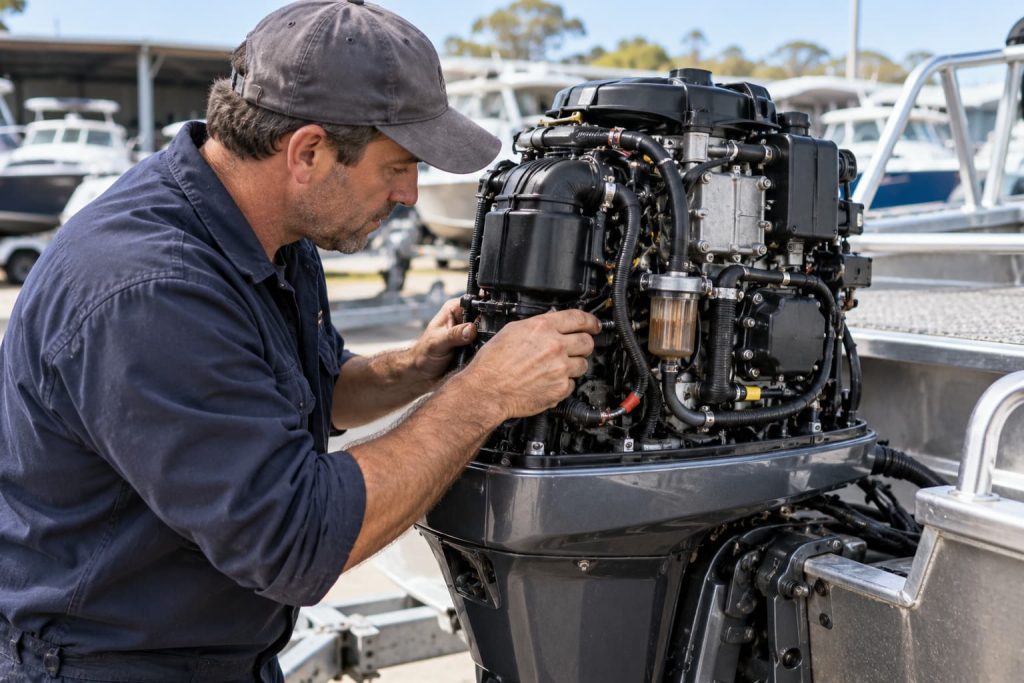
The engine can be one of the most expensive parts of a used boat to repair or replace. Even if the hull appears sound, an unreliable outboard can turn an attractive purchase into an ongoing expense.
Start by asking for the engine’s service history, approximate operating hours and any records of major repairs. Check that the engine serial number matches the available documentation. If the seller claims the motor has recently been serviced, ask for the invoice rather than relying solely on a verbal assurance.
Ask the seller not to warm up the engine before your inspection. A cold start can provide useful information about starting performance and idle behaviour. Observe how the engine starts, whether it idles consistently and whether any warning alarms appear. Unusual noises, persistent smoke after the initial start, fuel smells, visible leaks or signs of overheating warrant further investigation.
Inspect the engine externally for corrosion, damaged hoses, cracked wiring, oil leaks and neglected connections. Check the propeller and skeg for impact damage, and make sure the steering, gear controls and power trim and tilt operate correctly.
A visual inspection cannot establish the full condition of an engine. Where the motor’s history is uncertain, arrange for a qualified marine mechanic to assess it. Depending on the engine, this may include diagnostic checks, compression or leak-down testing, and an inspection of the cooling and fuel systems.
Do not assume that low engine hours automatically mean good condition. Poor maintenance, infrequent use and long periods of storage can also create problems.
6. Test the Electrical and Fuel Systems
Electrical faults can be difficult to track down, particularly on boats that have spent years in saltwater. Turn on the main electrical systems and check the battery, isolation switch, navigation lights, bilge pump, gauges and any fitted fish finder, sounder, GPS or radio.
Look for loose connections, exposed wiring, corrosion around terminals and improvised repairs. Wiring should be appropriately protected, supported and kept away from areas where it could be damaged or exposed to water. Check that batteries are securely installed and that the terminals are in reasonable condition.
Test the bilge pump and its float switch where fitted. If the boat has a battery charging system, ask when it was last checked. Faulty pumps, batteries and wiring can create inconvenience and, in some circumstances, a safety risk.
Inspect accessible fuel hoses, primer bulbs, filters, tank fittings and the fuel filler area. Look for cracked hoses, leaks, damaged clamps and strong fuel odours. Do not ignore signs of fuel leakage or attempt to test the system in a way that creates a fire risk.
Ask whether the fuel tank has been inspected or replaced and whether the boat has experienced fuel contamination. If you are unsure about the condition of the fuel system, have a qualified technician check it before using the boat.
7. Examine the Trailer, Tyres and Brakes
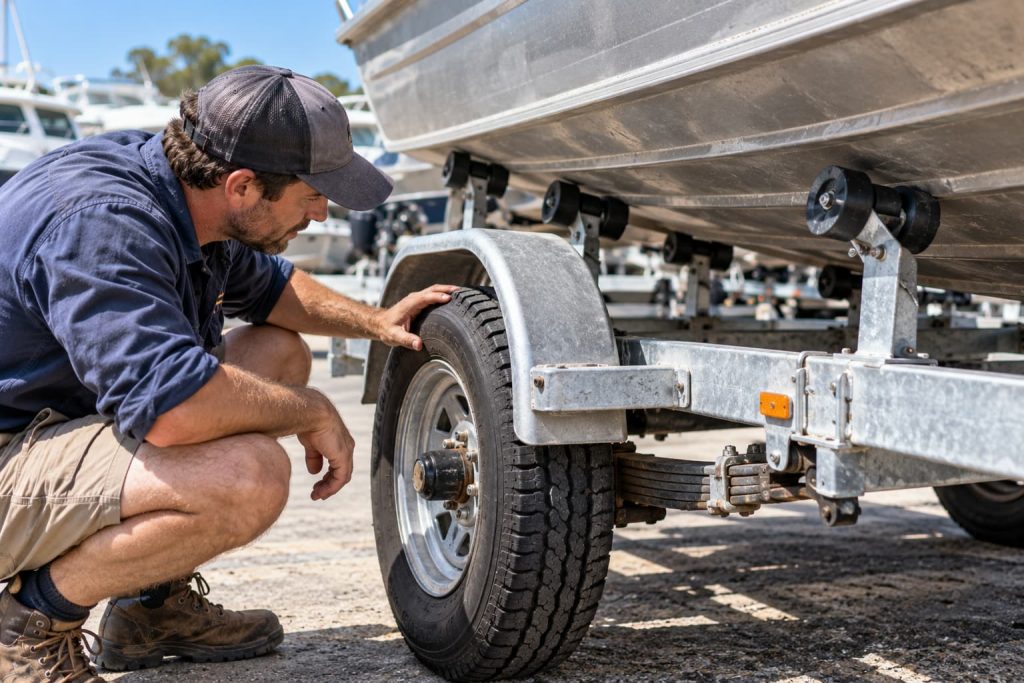
If the aluminium boat is sold with a trailer, remember that you are buying two assets. A poor trailer can add significant expense, even if the boat itself is in good condition.
Inspect the trailer chassis, drawbar, cross-members and welds for corrosion, cracks, distortion and evidence of previous repairs. Check the rollers or skids that support the hull, as damaged or incorrectly positioned supports can contribute to hull wear. Examine the winch, strap, coupling, jockey wheel and safety chains.
Look at the tyres for cracking, uneven wear and age-related deterioration. Check the spare tyre as well. If the trailer has brakes, make sure they are inspected and tested appropriately. Wheel bearings, hubs and suspension components also deserve attention, especially if the trailer has regularly been immersed in saltwater.
Test the trailer lights and inspect the wiring and plug. Confirm that the VIN or other required identification matches the available registration documents and that the trailer’s registration is current where required.
Finally, check the trailer’s load rating and compatibility with your towing vehicle. The combined load includes the boat, engine, trailer, fuel, batteries and equipment. Do not rely on the boat’s advertised dry weight alone when assessing towing requirements.
8. Check Safety Equipment and Onboard Accessories
Safety equipment can be expensive to replace, so establish exactly what is included in the sale and whether it is serviceable. Inspect the life jackets for condition and suitability, and check service requirements for inflatable models. Review the expiry dates and condition of flares where carried, and check the battery life and registration details of any EPIRB.
Test the marine radio, navigation lights, bilge pump and horn. Check the anchor, chain, ropes and other equipment for damage and suitability for the boat. If the boat has a fire extinguisher, confirm that it is appropriate and in serviceable condition.
The required equipment depends on the vessel and where it will be operated. Check the current rules for your state or territory and the type of water you intend to use. A boat set up for sheltered estuaries may need additional equipment and preparation before it is suitable for offshore trips.
Also test accessories such as the sounder, GPS, live bait tank, washdown pump and canopy. If an accessory is advertised as included, make sure it works or account for its repair or replacement in your budget.
9. Arrange a Sea Trial Before You Buy
A sea trial can reveal problems that are difficult to spot while the boat is sitting on its trailer. If conditions and arrangements permit, ask the seller to demonstrate the boat on the water before you finalise the purchase.
Pay attention to starting, idle, acceleration, steering response, gear engagement, engine temperature and warning alarms. Look for excessive vibration, unusual noises, inconsistent performance or water entering the bilge. Test the trim and any fitted systems during the trial, within safe operating limits.
Observe how the boat behaves at different speeds and whether it handles in a way that suits your intended use. If you plan to fish offshore, a brief run in sheltered water will not establish that the boat is suitable for every sea condition. Hull design, loading, weather and the operator’s experience all affect performance.
After returning, inspect the bilge and engine area again for water, leaks, fuel smells or other changes. A sea trial is not a substitute for a professional inspection, but it can help identify issues that deserve further investigation.
Never take a boat into unsuitable conditions simply to test it. The seller should agree to a safe, practical trial, and the boat should be operated by someone competent to do so.
10. When Should You Hire a Marine Surveyor?
A professional pre-purchase inspection is worth considering when the boat is expensive, older, has a complicated history or will be used regularly offshore. It is also sensible if you find unexplained damage, questionable welds, corrosion, engine problems or evidence of major repairs.
Choose an independent marine surveyor with relevant experience in aluminium construction. For a boat with an outboard motor, you may also need a separate inspection by a qualified marine mechanic. A hull survey and an engine assessment cover different areas, so clarify what each professional will examine.
Ask for a written report identifying defects, safety concerns, areas that could not be inspected and any recommended follow-up work. If repairs are required, obtain quotes before deciding whether to proceed.
A professional inspection costs money, but it can give you a clearer picture of the boat’s condition and help you avoid committing to repairs that exceed your budget. If the seller refuses reasonable access for an inspection or repeatedly discourages independent checks, consider that a reason to pause the purchase.
11. Is the Used Boat Right for Your Needs?
A boat can pass a basic inspection and still be the wrong choice. Think about where you plan to fish, how many people will normally come aboard, how far you expect to travel and whether you need a cabin or additional weather protection.
Consider the boat’s rated capacity, recommended engine power, fuel capacity, storage, towing requirements and the condition of its onboard equipment. A smaller boat that is easy to tow and maintain may be a better fit for estuary fishing, while regular offshore trips call for a careful assessment of hull design, seaworthiness, equipment and intended operating conditions.
Calculate the likely cost of ownership as well. Add the asking price to any immediate repairs, servicing, registration, insurance, fuel, trailer work and safety equipment you need to replace. This gives you a more realistic comparison between different used boats.
What to Look for When Comparing Used Sea Raider Boats
If you are considering a used Sea Raider aluminium fishing boat, compare its condition and equipment with the specifications for the relevant model. Sea Raider builds boats in different sizes and layouts, so check the hull identification details, original specifications, rated capacity, engine requirements and plate thickness for the particular vessel rather than assuming every model is identical.
Inspect the hull, welds, transom, engine mounting points and trailer just as carefully as you would on any other used aluminium boat. Ask for maintenance records and documentation of structural repairs or modifications. If the boat is intended for offshore fishing, pay particular attention to its mechanical condition, safety equipment and suitability for the trips you plan to make.
A recognised manufacturer and a solid-looking hull are not substitutes for checking the individual boat. Its maintenance history, previous use and present condition are what matter when deciding whether it is a sound purchase.
Final Checklist Before Buying a Used Aluminium Boat
Before paying a deposit or agreeing to the sale, make sure you have:
- Checked the hull for dents, cracks, corrosion and poor repairs.
- Inspected accessible welds, chines, frames and transom connections.
- Examined the deck, floor, fittings and bilge.
- Reviewed engine service records and arranged mechanical checks if needed.
- Tested the electrical systems, fuel system and onboard accessories.
- Inspected the trailer, tyres, bearings, brakes and lights.
- Checked the safety equipment and its service requirements.
- Verified the HIN, registration and seller’s ownership details.
- Completed the appropriate PPSR searches for the boat and trailer.
- Arranged a sea trial and considered an independent pre-purchase inspection.
- Estimated the cost of repairs and ongoing ownership before making an offer.
Frequently Asked Questions
Start with the boat’s history, identification and overall condition. Then inspect the hull for damage and corrosion, paying particular attention to welds, chines and the transom. These checks can help you identify major concerns before spending time and money on a more detailed inspection.
Look for deep dents, creases, cracks, holes, distorted panels and signs of poorly completed repairs. Inspect the keel, chines and structural connections closely. If you find damage that may affect the hull’s integrity, ask a qualified professional to assess it before buying.
It depends on its location and severity. Minor surface oxidation is not necessarily a structural concern, but deep pitting, material loss and corrosion around welds or fittings can be serious. Corrosion associated with dissimilar metals or electrical faults should be investigated to identify and address the cause.
A survey is particularly worthwhile for older, expensive or offshore-capable boats, or where the hull condition and repair history are uncertain. An independent surveyor can identify concerns that may not be obvious to a buyer. You may also need a separate mechanical inspection of the engine.
Review the service history, inspect for corrosion and leaks, and observe a cold start where possible. Check the propeller, skeg, steering and trim and tilt. For a more reliable assessment, arrange a marine mechanic’s inspection, which may include diagnostic checks and compression testing where appropriate.
Missing records do not automatically rule out a boat, but they increase uncertainty about how it has been maintained. Ask the seller for other evidence of servicing and repairs, then arrange an independent mechanical inspection if necessary. Factor any unknown maintenance or likely repairs into your offer.
Use the Australian Government’s Personal Property Securities Register and search using the boat’s HIN or official number. Complete the search close to the purchase date. If a trailer is included, conduct a separate vehicle search using its VIN where applicable.
A sea trial is strongly recommended where practical because it allows you to assess starting, acceleration, steering, vibration and performance under load. It may reveal problems that are not obvious on land. Arrange it safely and remember that it does not replace a professional survey or engine inspection.
Serious warning signs include cracked structural welds, deep corrosion, unexplained hull distortion, damage around engine mounting points, fuel leaks, persistent engine alarms and poorly documented structural repairs. A seller who will not allow reasonable inspection or verification of ownership also warrants caution.
There is no reliable fixed amount because repair costs depend on the boat’s size, age, condition and equipment. Obtain quotes for any significant hull, engine or trailer work before committing. Keep a separate allowance for routine servicing, safety equipment, registration, insurance and other ongoing expenses.
Important note: This guide is general buying advice, not a substitute for a professional marine survey or mechanical assessment. Registration, safety equipment and operating requirements vary across Australian states and territories, so confirm the applicable requirements before taking the boat on the water.