What fishing electronics do I need on my boat in Australia?
Most recreational fishing boats benefit from three essential pieces of marine electronics: a fish finder or sounder, a GPS chartplotter and a VHF marine radio. A fish finder helps identify fish, water depth and underwater structure, while a GPS chartplotter shows your position, marine charts, navigation routes and saved fishing locations. A VHF radio provides communication with other vessels and marine rescue services. For regular offshore fishing, additional equipment such as radar, AIS and an autopilot may also be worth considering. The right setup depends on your boat size, fishing locations, budget and how far you travel offshore.
Modern marine electronics have changed the way people fish from boats. A good sounder can reveal underwater structure that would otherwise be difficult to identify, while GPS chartplotters make it easier to return to productive fishing locations and navigate unfamiliar waters. Add a reliable marine radio and you have a much more useful setup for spending time on the water.
However, choosing marine electronics can become confusing. Manufacturers offer different displays, sonar technologies, transducers, chart options and networking features. Some units combine several functions in one screen, while others are designed to perform a single job.
You do not necessarily need the most expensive equipment available. What matters is choosing electronics that suit your boat, fishing style and usual operating conditions. Here is what to consider before investing in a new marine electronics setup.
1. Understanding the Main Types of Fishing Boat Electronics
Before comparing individual units, it helps to understand what each piece of equipment does. The terms fish finder, sounder and GPS chartplotter are sometimes used interchangeably, but they do not all perform the same function.
A fish finder uses sonar to display information about fish, water depth and underwater structure. A sounder measures depth and shows what is happening beneath the boat. Many modern fish finders combine these functions.
A GPS chartplotter uses satellite positioning and electronic marine charts to show where your boat is located. It can also store waypoints, record tracks and help plan routes.
A VHF marine radio is used to communicate with other boats, marine rescue organisations and shore stations. It is an important safety component, particularly when travelling offshore.
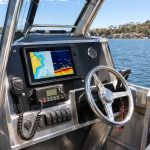
Some multifunction displays combine sonar, GPS chartplotting and other compatible systems on one screen. This can save space at the helm and make it easier to monitor several types of information while fishing.
2. Fish Finders and Sounders: What Is the Difference?
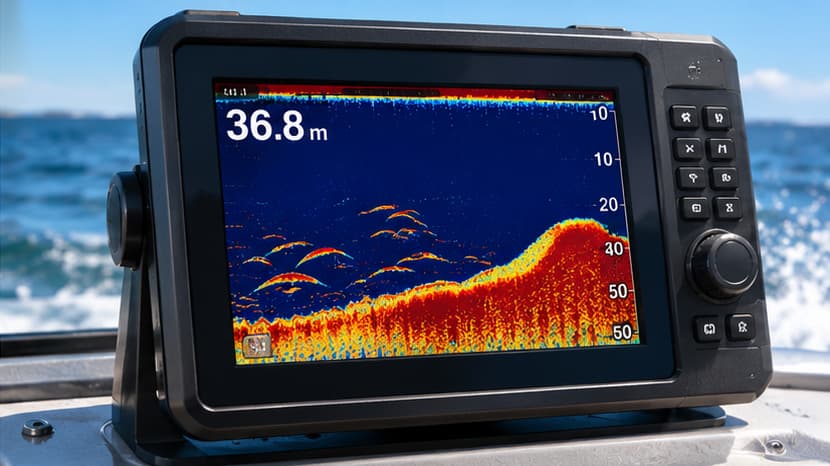
A fish finder and a sounder both use sonar technology, which sends sound pulses into the water and processes the returning echoes. The display converts this information into a visual representation of the water beneath the boat.
A basic sounder primarily shows water depth and the shape or hardness of the seabed. A modern fish finder provides additional information that can help anglers identify fish returns, bait schools, reef edges, drop-offs and other underwater features.
For example, if you are fishing around a reef, the sounder can help identify changes in bottom depth and structure. You may also see returns that could indicate fish holding close to the bottom or suspended in the water column.
It is important to remember that a fish finder does not identify every fish with certainty. Its display needs to be interpreted, and the quality of the information depends on the transducer, installation, water conditions, boat speed and settings. Learning to read the screen takes practice.
What Is CHIRP Sonar?
CHIRP stands for Compressed High-Intensity Radiated Pulse. Rather than transmitting a single frequency, CHIRP sonar transmits a range of frequencies across a selected band. This can provide clearer returns and better separation between targets than conventional single-frequency sonar, depending on the equipment and conditions.
For anglers who regularly fish different depths, CHIRP can be a worthwhile feature. It can help distinguish fish from nearby structure and provide more useful detail when searching for bait or bottom-hugging species.
What Are Down Imaging and Side Imaging?
Down imaging provides a more detailed view of the structure directly beneath the boat. It can help reveal reef formations, timber, rocks and other underwater features.
Side imaging scans areas to either side of the boat, allowing anglers to search a wider area without passing directly over every potential fishing location. This can be useful when exploring unfamiliar waterways or looking for isolated structure.
These technologies are helpful additions, but they are not essential for every boat owner. A quality conventional or CHIRP sounder with a correctly installed transducer may be more useful than an advanced imaging system that is poorly matched to the boat.
3. The Importance of Choosing the Right Transducer
The transducer is one of the most important parts of a fish finder installation. It sends sonar signals into the water and receives the returning echoes. Even an expensive display can deliver disappointing results if the transducer is unsuitable or incorrectly installed.
There are several transducer mounting options. Transom-mounted units are attached to the rear of the boat and are common on trailerable fishing boats. Through-hull and in-hull installations are other options, depending on the hull design and equipment requirements.
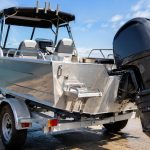
For aluminium boats, the mounting position needs particular attention. The transducer should have a suitable view of the water and be positioned to minimise turbulence, interference and aeration. Poor placement can cause the sounder to lose its reading when the boat gets onto the plane.
Before purchasing a unit, check that the display and transducer are compatible. Consider the operating depth, frequency, beam angle and sonar features you actually need. If you are unsure about installation on an aluminium hull, speak to the boat manufacturer or an experienced marine electronics installer.
4. GPS Chartplotters: More Than Just Showing Your Location
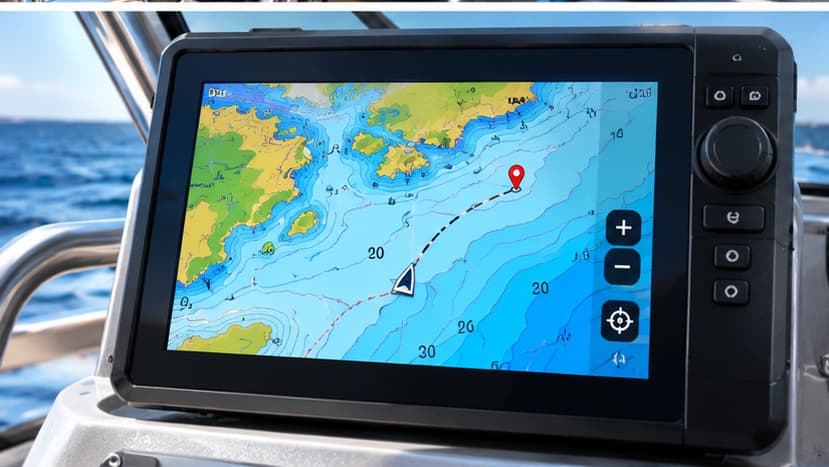
A marine GPS chartplotter uses satellite positioning to show your boat’s location on an electronic marine chart. Unlike a basic GPS device that only displays coordinates, a chartplotter places your position against mapped coastal features, depth contours, navigation markers and other chart information.
One of the most useful features is the ability to save waypoints. If you locate a productive reef, bait school or fishing ground, you can save its coordinates and return to the area later. You can also record tracks and create routes between locations.
For Australian anglers who regularly fish offshore, accurate chart information is particularly useful when navigating unfamiliar areas. Depth contours can help identify drop-offs and underwater formations, while navigation markers provide additional reference points.
However, electronic charts should not be treated as infallible. Chart coverage and detail vary, and conditions can change. Keep appropriate backup navigation methods available and maintain awareness of your surroundings.
Standalone GPS or Fish Finder and GPS Combo?
A standalone GPS chartplotter is designed primarily for navigation, while a combined fish finder and GPS unit brings sonar and charting together on one display.
For many recreational fishing boats, a combo unit offers good value and saves space at the helm. It allows the skipper to monitor depth and sonar returns while checking position and chart information.
A larger boat or a serious offshore setup may benefit from separate displays. This allows the skipper to keep navigation visible while monitoring sonar information on another screen. The best arrangement depends on the available helm space, budget and how much information you want to view at once.
5. VHF Marine Radios: An Important Part of Your Setup
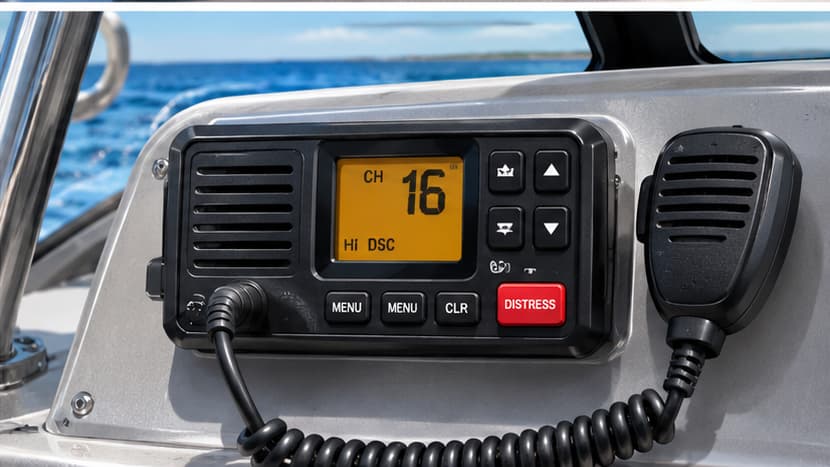
A VHF marine radio is not a fishing accessory, but it is one of the most important pieces of equipment on a boat. It allows communication with nearby vessels, shore stations and marine rescue services.
When choosing a radio, consider a fixed-mount unit with an appropriately installed antenna. Antenna height and installation have a major influence on communication range. A handheld VHF can provide useful backup, but it should not automatically replace a suitable primary communication system.
Digital Selective Calling (DSC) is another feature worth considering. Compatible radios can send a digital distress alert, and when connected to GPS, the alert can include the boat’s position.
Australian operators using VHF marine radio within Australian territorial waters generally need the appropriate qualification or supervision by someone who holds it. Check the current Australian Communications and Media Authority requirements before operating the radio.
Do not rely on a mobile phone as your only means of emergency communication offshore. Mobile coverage can disappear quickly once you travel away from the coast.
6. Other Marine Electronics Worth Considering
Once the basic sounder, GPS and radio are covered, there are other systems that may improve offshore awareness and convenience.
Radar: Marine radar can help detect nearby vessels, land and other objects, particularly in poor visibility or at night. It is more relevant for larger boats and those regularly travelling offshore or in busy waterways.
AIS: Automatic Identification System equipment can display information from compatible vessels, helping you identify and monitor nearby traffic. It can be particularly useful in busy shipping areas, although not every vessel transmits AIS information.
Autopilot: An autopilot can maintain a selected heading and reduce the need for constant manual steering. It is useful on longer runs, but the skipper must remain alert and responsible for navigation and collision avoidance.
Marine compass: A compass provides an independent direction reference if electronic navigation equipment loses power or stops working. It remains a useful part of a well-equipped boat.
Radar and night vision cameras: These can be valuable additions for boats that regularly operate after dark or in challenging visibility. Their suitability depends on the vessel, intended use and installation.
You do not need every available system. Choose equipment based on the conditions you actually encounter rather than filling the helm with screens and features that rarely get used.
7. What Marine Electronics Do You Need for Different Types of Fishing?
The best marine electronics setup depends on where you fish and how you use your boat.
For estuary and inshore fishing, a quality fish finder with GPS chartplotting is usually a sensible starting point. It can help identify channels, drop-offs, shallow areas and productive structure. A marine radio is also worth including, particularly if you travel beyond sheltered waterways.
For reef and offshore fishing, a more capable sounder and chartplotter become increasingly useful. Look for suitable sonar performance at your usual fishing depths, reliable chart coverage and a display that remains easy to read in bright sunlight. A fixed VHF radio, suitable antenna and required distress equipment should also be considered.
For regular long-distance offshore trips, additional systems such as radar, AIS and autopilot may be worthwhile. The value of these systems depends on the boat’s size, operating conditions and the experience of the skipper.
8. How to Choose the Right Display and Installation
A marine electronics display needs to be easy to read and operate from the helm. Screen size is important, but it should be considered alongside resolution, brightness, mounting position and available space.
A larger screen makes split-screen viewing more practical. You might want to display a marine chart on one side and sonar returns on the other. However, a large unit is not automatically better if it blocks visibility or makes the helm difficult to operate.
Look for a sunlight-readable display with controls you can use comfortably while wearing wet hands or gloves. Touchscreens are convenient, but physical buttons or rotary controls can be useful when conditions are rough.
Installation also deserves attention. Wiring should be suitable for the marine environment, connections properly sealed and circuits appropriately protected. Consider whether the system needs networking between displays, radios, engine data and other equipment.
Before installation, plan where the transducer, antenna, display and cables will sit. A tidy installation is easier to maintain and reduces the risk of interference or accidental damage.
9. How Much Should You Spend on Fishing Boat Electronics?
There is no single price that suits every boat. A basic fish finder and GPS combo can be a sensible starting point for casual fishing, while advanced sonar, larger displays, radar and networked systems can increase the total cost considerably.
Rather than buying the most expensive unit available, work out what information you need. If you mainly fish inshore, a reliable combo display and suitable transducer may cover most of your requirements.
If you regularly fish offshore, it may be worth allocating more of your budget to sonar performance, chart quality, display visibility and dependable communication equipment. Remember to include installation, transducer selection, antennas, networking components and chart subscriptions where applicable.
It is also worth checking whether the boat manufacturer or dealer can supply and commission the equipment. A professionally planned installation can save time and reduce compatibility problems later.
10. Choosing Marine Electronics for a Sea Raider Boat
Sea Raider offers electronics and navigation options across its aluminium fishing boat range, allowing buyers to specify equipment according to their intended use.
For example, the 6.25m, 6.85m and 7.5m Pro Fisher models offer optional Garmin and Simrad electronics packages, with selected Garmin ECHOMAP Ultra 2 displays and compatible transducers. Radar, VHF radio, antenna and NMEA 2000 autopilot integration are also available options, depending on the model and configuration.
The 7.5m Pro Fisher is designed for offshore fishing and offers a transducer mounting bracket as part of its listed equipment. Buyers can discuss their preferred sounder, chartplotter and navigation package when specifying the boat.
The important thing is to plan the electronics around the way you intend to fish. Someone regularly working offshore reefs may have different requirements from an owner who mainly fishes estuaries or sheltered coastal waters. Sea Raider can help match the available equipment packages and installation to the selected boat and its intended use.
Final Thoughts
A well-planned marine electronics setup makes fishing more organised and helps you understand what is happening around and beneath your boat. For most fishing boat owners, a quality fish finder or sounder, GPS chartplotter and VHF radio form a sensible starting point.
From there, consider whether CHIRP, side imaging, radar, AIS or autopilot will genuinely improve the way you use the boat. Pay attention to transducer compatibility, screen placement, chart coverage and professional installation rather than choosing equipment based on specifications alone.
The best setup is not necessarily the one with the most screens. It is the one that gives you clear information, dependable navigation and suitable communication for the waters you fish.
Frequently Asked Questions
Both use sonar technology to measure depth and display information beneath the boat. A sounder traditionally focuses on depth and bottom information, while a fish finder provides additional sonar features to help identify fish and underwater structure. Many modern units combine both functions.
Not necessarily. Many modern marine displays combine GPS chartplotting and sonar in one unit. A combo is often suitable for smaller and medium-sized fishing boats, while larger vessels may benefit from separate displays for easier viewing and additional functionality.
CHIRP sonar transmits across a range of frequencies rather than using just one frequency. It can provide clearer returns and better separation between targets, depending on the equipment and conditions. It is worth considering if you regularly fish different depths or need more detail from your sounder.
The right size depends on the available helm space and how much information you want to display. Smaller screens can suit compact boats, while larger displays make split-screen navigation and sonar viewing easier. Check visibility, resolution and mounting position before choosing.
Yes, provided the unit and transducer are suitable for the depth and conditions. Lower frequencies are generally better suited to deeper water, while higher frequencies can provide greater detail in shallower water. Performance also depends on installation and settings.
A transducer is commonly mounted at the transom, although other installation methods may be suitable depending on the boat and equipment. It needs a clear flow of water without excessive turbulence or aeration. Follow the transducer manufacturer’s installation instructions and seek professional advice if needed.
A suitable marine radio is an important safety consideration for offshore boating. Requirements vary according to the vessel and operating area. A fixed-mount VHF radio with a properly installed antenna is a common choice, and operators should understand the relevant Australian qualification requirements.
Not every recreational fishing boat needs radar. It becomes more useful for larger boats, regular offshore operation, night travel and situations where visibility may be reduced. Consider your operating conditions, budget and ability to interpret radar information before investing.
Some equipment can be installed by an experienced owner, but transducer placement, electrical wiring, antenna installation and network integration require care. Incorrect installation can affect performance and may create electrical or warranty problems. Use a qualified marine installer or electrician where appropriate.
A capable fish finder or sounder, GPS chartplotter and fixed VHF radio are a sensible foundation. Depending on the boat and operating conditions, radar, AIS and autopilot may also be useful. Choose equipment that suits your normal fishing depth, distance from shore, boat size and available helm space.
Important note: Marine electronics do not replace safe navigation, local knowledge or required safety equipment. Check the current boating and radio requirements for the state or territory where you operate, maintain appropriate backup navigation methods and ensure distress equipment is suitable for your trips.