How do you calculate boat towing capacity in Australia?
To calculate boat towing capacity, you need to check the fully loaded weight of the boat and trailer, the trailer’s Aggregate Trailer Mass (ATM) and Gross Trailer Mass (GTM), the towball weight, and your vehicle’s towing limits. ATM is the total permitted mass of the loaded trailer, including the weight transferred to the tow vehicle through the coupling. GTM is the portion carried by the trailer’s wheels when hitched, while towball mass is the downward load placed on the vehicle’s towball. You must also check your vehicle’s braked towing capacity, Gross Vehicle Mass (GVM), Gross Combination Mass (GCM), payload and towbar rating. Remember to include the outboard, fuel, batteries, safety equipment and fishing gear when calculating your loaded boat weight.
Why boat towing capacity involves more than the boat’s advertised weight
A boat’s brochure weight is only one part of the calculation. The figure may describe the hull without the outboard, fuel, batteries, electronics, safety equipment or other gear. Once the boat is ready for a day on the water, its actual weight can be considerably higher.
The trailer adds another layer. It has its own tare mass, carrying capacity and maximum ratings. When the trailer is connected to the vehicle, some of its weight is carried by the tow vehicle through the towball, while the rest remains on the trailer’s wheels. This is why ATM, GTM and towball mass are separate figures rather than interchangeable terms.
The safest approach is to work out the weight of the complete boat and trailer in the condition you intend to tow it, then check that every part of the combination is within its rated limits.
1. What is ATM (Aggregate Trailer Mass)?
Aggregate Trailer Mass, commonly called ATM, is the maximum permitted mass of a fully loaded trailer when it is not connected to the tow vehicle. It includes the trailer itself, the boat, engine, fuel, batteries, water and equipment carried on board.
When measuring ATM, the trailer is supported independently, with the coupling supported by a jockey wheel or suitable weighing arrangement. The figure includes the weight that will eventually be transferred to the tow vehicle through the towball.
For example, imagine a boat trailer with a tare mass of 500kg. Once the boat, outboard, fuel and equipment are added, the complete loaded trailer weighs 1,900kg. Its actual ATM is therefore 1,900kg. If the trailer has a manufacturer-rated ATM of 2,000kg, it is within that particular limit, provided its other ratings are also satisfied.
The important distinction is that ATM is a manufacturer’s rating, not simply a weight you calculate from the boat’s specifications. You need to check the trailer compliance plate to find its maximum permitted ATM.
2. What is GTM (Gross Trailer Mass)?
Gross Trailer Mass, or GTM, is the maximum permitted mass carried through the trailer’s wheels and axles when it is connected to the tow vehicle.
Once a loaded boat trailer is hitched up, its weight is shared between two places. The trailer wheels carry one portion, while the tow vehicle supports the remaining portion through the towball. GTM refers to the load carried through the trailer wheels, not the total weight of the complete trailer and boat.
This is why GTM is normally lower than ATM. The difference between the two measurements represents the towball mass when the trailer is loaded and positioned as specified by its manufacturer.
For instance, if a loaded trailer has an ATM of 1,900kg and a measured towball mass of 190kg, the GTM would be approximately 1,710kg.
You must check both ratings on the trailer compliance plate. Being under the ATM limit does not automatically mean the trailer is within its GTM limit. The axle, suspension, wheels and tyres must also be suitable for the load they carry.
3. What is towball weight or towball mass?
Towball weight, also known as towball mass (TBM) or ball load, is the downward force that a loaded trailer places on the tow vehicle’s towball.
It matters because this weight becomes part of the load carried by the vehicle. It affects the vehicle’s rear axle load and available payload, so it needs to be considered alongside passengers, luggage, accessories and other equipment.
For example, if your loaded boat trailer weighs 1,900kg and places 190kg on the towball, the trailer’s wheels carry the remaining 1,710kg. The 190kg is transferred to the tow vehicle and contributes to its load.
A suitable towball load also helps the trailer remain stable. Too little downward load can contribute to trailer sway, while too much can overload the towbar, rear axle or vehicle. There is no single percentage that should be applied to every boat and trailer combination. Follow the trailer and vehicle manufacturers’ requirements, and make sure the actual measured ball load is within every applicable limit.
4. ATM vs GTM vs towball weight: What is the difference?
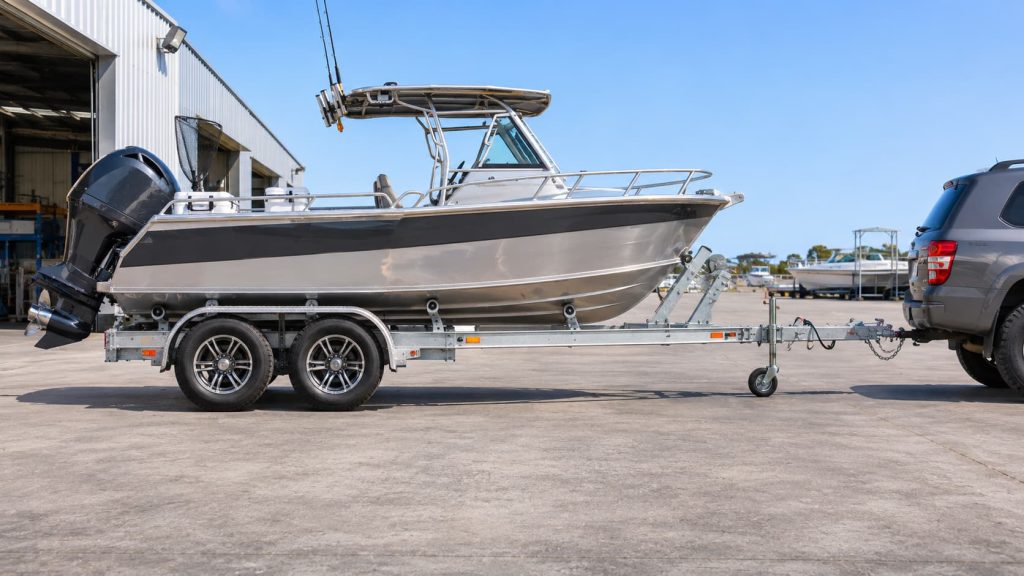
These three terms describe different parts of the same loaded trailer. Understanding how they relate makes it easier to check whether your boat trailer is suitable for your vehicle.
| Term | What it measures | When it applies |
|---|---|---|
| ATM | Total permitted mass of the loaded trailer, including the coupling load | Trailer standing independently |
| GTM | Permitted mass carried through the trailer wheels | Trailer connected to the tow vehicle |
| Towball mass | Downward load transferred to the tow vehicle | Trailer connected to the tow vehicle |
| Tare mass | Unladen weight of the trailer | Trailer without its load |
When comparing actual measurements for the same load, the relationship is:
ATM = GTM + towball mass
For example:
- Loaded trailer ATM: 1,900kg
- Towball mass: 190kg
- Trailer weight carried through the wheels: 1,710kg
This gives an actual GTM of approximately 1,710kg.
Remember that ATM and GTM are manufacturer-rated limits. The figures above illustrate how the actual weight is distributed, rather than changing the trailer’s rated capacity.
5. How to calculate the actual loaded weight of your boat
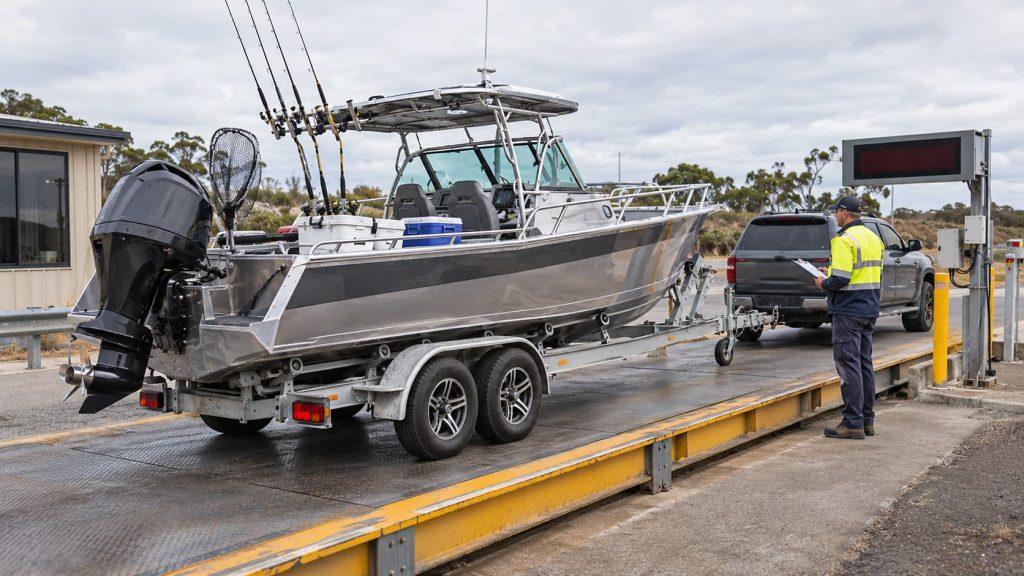
One of the most common mistakes when choosing a boat trailer is using the hull’s advertised dry weight as the total towing weight. A boat is rarely towed in the same condition in which it leaves the factory.
To calculate the loaded boat weight, add the weight of everything that will be carried on the boat when travelling. This usually includes:
- Hull and factory-fitted equipment
- Outboard motor and associated equipment
- Fuel in the tank
- Batteries and electrical accessories
- Freshwater in tanks, where fitted
- Anchors, ropes and safety equipment
- Fishing rods, tackle and other gear
- Electronics, including GPS, sounders and radios
- Additional accessories and aftermarket fittings
You also need to account for the trailer’s own weight. The complete loaded trailer, rather than just the boat, is what matters when checking ATM.
Example: Working out a loaded boat and trailer weight
Consider a boat with the following illustrative weights:
| Component | Weight |
|---|---|
| Boat hull and fitted equipment | 1,000kg |
| Outboard motor | 250kg |
| Fuel | 120kg |
| Batteries | 50kg |
| Safety equipment and fishing gear | 80kg |
| Loaded boat weight | 1,500kg |
| Trailer tare mass | 400kg |
| Total loaded trailer weight | 1,900kg |
In this example, the loaded boat weighs 1,500kg, but the complete trailer combination weighs 1,900kg.
If the trailer has an ATM rating of 2,000kg, the example combination is 100kg below that rating. However, you still need to check GTM, towball mass, axle and tyre ratings, and the vehicle’s towing and load limits.
This calculation is a useful starting point, but weighing the complete combination in its normal towing condition is the best way to confirm the actual figures.
6. How to check whether your vehicle can tow your boat
A vehicle’s advertised towing capacity is not the only number you need to consider. The tow vehicle has several weight limits, and exceeding any one of them can make the combination unsuitable for towing.
Start with the following specifications in the vehicle handbook or manufacturer’s documentation.
Braked towing capacity: This is the maximum permitted trailer mass the vehicle can tow when the trailer has an appropriate braking system. Check the manufacturer’s definition and requirements, and compare the rating with the actual loaded trailer and applicable ATM limit.
Towball rating: This is the maximum downward load that the towbar and vehicle are designed to support. The permitted ball load must not exceed the lowest applicable rating across the vehicle, towbar and coupling.
Gross Vehicle Mass (GVM): This is the maximum permitted loaded weight of the tow vehicle itself. It includes the vehicle, occupants, luggage, accessories and the towball load transferred from the trailer.
Gross Combination Mass (GCM): This is the maximum permitted combined mass of the loaded tow vehicle and loaded trailer. You need to account for the people and equipment inside the vehicle as well as the boat and trailer.
Rear axle and tyre ratings: A suitable overall towing capacity does not guarantee that the rear axle or tyres can handle the load. Towball weight increases the load carried by the rear of the vehicle, so axle and tyre limits need to be checked as well.
For a safe towing setup, the vehicle, towbar, coupling and trailer must all be within their respective limits. It is important to check the vehicle manufacturer’s towing recommendations and towbar rating rather than relying on the advertised towing capacity alone.
7. How to weigh a boat and trailer correctly
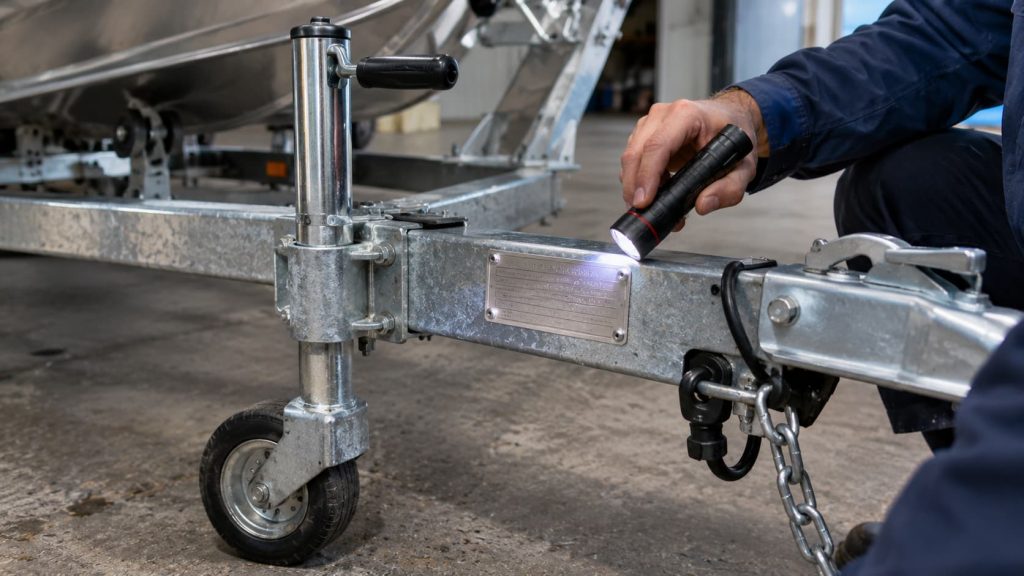
Calculations based on brochure specifications are useful when comparing boats, but they cannot always account for the equipment and accessories fitted to an individual boat. Weighing the loaded combination gives you a more reliable picture.
Before visiting a weighbridge, prepare the boat as you would for a normal trip. Include the outboard, fuel, batteries, safety equipment, fishing gear and any other items that usually remain on board. Make sure the trailer is also in its normal towing configuration.
A practical weighing process is:
- Weigh the complete loaded trailer: Have the boat and trailer weighed in the condition you intend to tow them. This helps establish the actual loaded mass.
- Measure the towball load: Use suitable ball-weight scales or an appropriate weighbridge arrangement to establish the downward load at the coupling.
- Determine the GTM: The actual GTM is the load carried through the trailer wheels when hitched. It can be checked using suitable weighing equipment.
- Compare the measurements with the ratings: Check the actual figures against the ATM, GTM, towball, axle and tyre limits, as well as the vehicle’s specifications.
Do not rely on a single weighbridge reading to confirm every limit. The weighing method needs to account for how the load is distributed between the trailer wheels and coupling. If you are unsure how to measure each figure, ask a qualified weighbridge operator or trailer specialist for assistance.
8. Common boat towing mistakes to avoid
Even an appropriately sized vehicle and trailer can become an unsuitable combination if the load is not managed properly. These are some common mistakes worth avoiding.
Using the hull’s dry weight: The advertised hull weight rarely represents the boat as it will be towed. Always account for the engine, fuel, batteries and equipment.
Ignoring trailer tare mass: The trailer itself can contribute a substantial amount to the total towing weight. Remember to add it when calculating ATM.
Checking ATM but ignoring GTM: The complete trailer might be below its ATM rating while the load carried through its wheels exceeds the GTM rating.
Overloading the towball: A heavy boat does not automatically mean the vehicle can support the required ball load. Check the towbar, vehicle, coupling and rear axle limits.
Leaving extra equipment on board: Anchors, fishing gear, spare batteries, toolboxes and other accessories all contribute to the loaded weight. Small additions can make a difference when a trailer is already close to its limit.
Assuming a vehicle’s towing capacity is the only restriction: GVM, GCM, axle ratings, tyre ratings and towball limits also matter.
A little preparation before leaving home can help prevent unnecessary problems on the road and at the boat ramp.
9. Choosing a suitable trailer for your Sea Raider boat
When choosing a trailer for a Sea Raider boat, the key consideration is the weight of the complete boat and trailer package, rather than the hull’s length or dry weight alone.
The trailer needs to be suitable for the boat’s loaded weight and dimensions, with sufficient ATM and GTM ratings. Its configuration should also suit the boat’s hull design and provide appropriate support during transport and launching.
Before selecting a trailer, consider the engine fitted to the boat, fuel capacity, batteries, electronics and the equipment you normally carry. A boat that is suitable for one trailer configuration may need a higher-rated option when fitted with additional equipment.
It is also important to check that the towing vehicle can handle the complete loaded combination. If you are unsure which trailer rating or setup is appropriate, speak with the Sea Raider team and confirm the relevant specifications before making a decision.
Final thoughts
Understanding boat towing capacity is about more than checking how much weight your vehicle can pull. ATM, GTM, towball mass and loaded boat weight all describe different parts of the towing setup, and each needs to be considered before you head out.
Start by calculating the complete loaded weight of your boat and trailer. Check the trailer’s compliance plate, measure the actual towball load and compare the results with your vehicle’s towing, payload and combination limits. If the numbers are close to a maximum rating, have the setup checked by a qualified trailer specialist rather than relying on estimates.
Taking the time to get these figures right helps you choose suitable equipment, protect your boat and trailer, and tow with greater confidence.
Frequently asked questions about boat towing capacity
ATM stands for Aggregate Trailer Mass. It is the maximum permitted mass of a fully loaded trailer when it is not connected to the tow vehicle. It includes the trailer, boat, engine, fuel, batteries and equipment, as well as the load that will be transferred through the coupling.
ATM is the total permitted mass of the loaded trailer, including the coupling load. GTM is the permitted mass carried through the trailer’s wheels when it is connected to the tow vehicle. The difference between the actual ATM and GTM measurements represents the towball mass.
The correct towball weight depends on the trailer design and the towing vehicle’s specifications. Some general towing guides discuss a percentage of the loaded trailer mass, but this should not be treated as a universal rule. Follow the trailer manufacturer’s recommendations and ensure the towball load stays within the limits of the vehicle, towbar and coupling.
It should when calculating the loaded boat weight. You need to include the hull, outboard, fuel, batteries, water, electronics, safety equipment and any other items carried on board. The trailer’s tare mass must then be added to calculate the complete loaded trailer weight.
Add the loaded boat weight to the trailer’s tare mass. For example, if your boat weighs 1,500kg when fully equipped and the trailer weighs 400kg, the complete loaded trailer weighs 1,900kg. A weighbridge measurement can confirm the actual figure.
Not necessarily. You need to consider the complete loaded trailer weight and check it against the relevant vehicle and trailer limits. Towball load, GVM, GCM, rear axle capacity, tyre ratings and towbar specifications can all affect whether the combination is suitable.
Look for the trailer compliance plate, which is commonly fitted to the drawbar or trailer frame. It contains important information about the trailer’s rated capacities. If the plate is missing or difficult to read, contact the trailer manufacturer or a qualified trailer specialist.
Yes. A larger or heavier outboard increases the loaded weight of the boat and trailer combination. Additional batteries, fuel, electronics and other equipment can increase it further. Recalculate the loaded weight and check the trailer and vehicle ratings after making changes.
A weighbridge is not necessarily required for every trip, but weighing the complete loaded setup is a reliable way to confirm its actual mass. It is particularly useful when the boat has been modified, fitted with a larger engine or loaded with additional equipment, or when the estimated weight is close to a rated limit.
Suggested sources for editorial reference
These sources informed the technical explanations and examples above. The Australian Government document is the primary reference for trailer standards, while the other sources provide practical towing and boat-trailer guidance.
- Australian Government: Vehicle Standards Bulletin 1, Revision 6. Current trailer standards guidance, including ATM and GTM definitions.
- RACQ: Trailer and Tow Vehicle Specifications. Explains trailer mass terminology and vehicle towing limits. Its regulatory information is Queensland-specific.
- Club Marine: Buyers’ Guide to Boat Trailers. Covers trailer sizing, loaded boat weight, fuel, equipment and weight distribution.
- Boatsales: Towing Big Boats in Australia Explained. Practical explanation of boat trailer tare, GTM, ATM and towball mass.
- Sea Raider: What Size Boat Trailer Do I Need? Relevant internal reference for trailer selection and loaded boat weight.
Editorial note: Towing requirements and vehicle ratings can vary by vehicle, trailer and state or territory. The article deliberately avoids presenting one towball-weight percentage as a universal legal requirement. Before publication, have any model-specific trailer ratings or towing claims checked against the relevant manufacturer’s current documentation.